PRIM Framework Explained
PRIM means Portfolio Management Service Route for Investment in Mutual Fund Units. It is a new, specialised portfolio-management route introduced under Chapter VI of the SEBI (Portfolio Managers) Regulations, 2026.
The framework becomes effective on 1 April 2027. It is intended for portfolio managers whose client portfolios will be invested exclusively in permitted mutual-fund products, rather than directly in shares, bonds or other securities. SEBI Portfolio Managers Regulations 2026
1. What PRIM permits
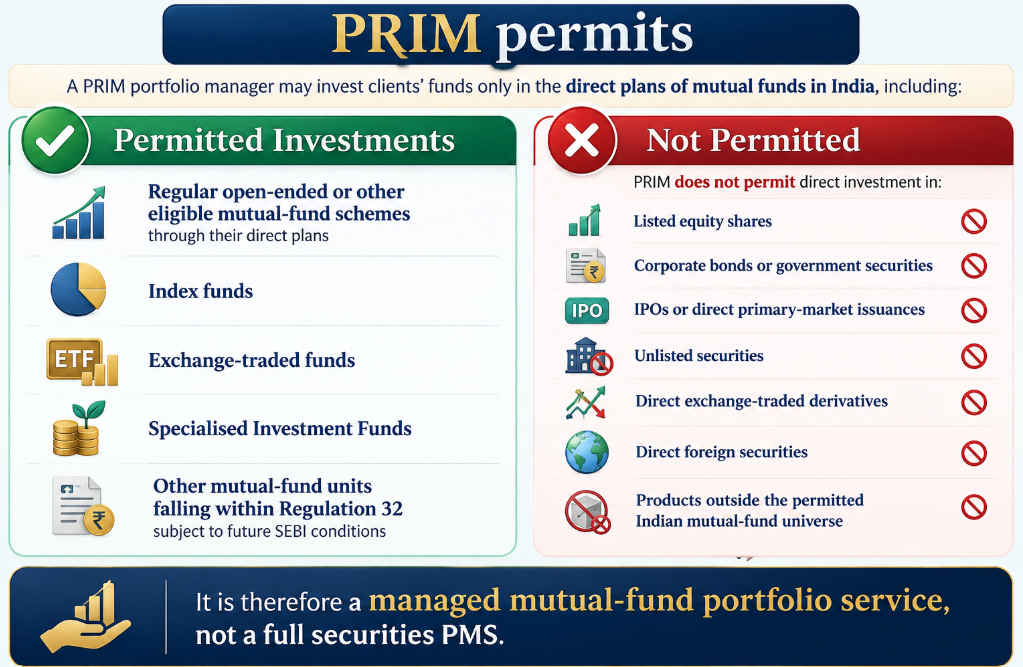
A PRIM portfolio manager may invest clients’ funds only in the direct plans of mutual funds in India, including:
Regular open-ended or other eligible mutual-fund schemes through their direct plans;
Index funds;
Exchange-traded funds;
Specialised Investment Funds; and
Other mutual-fund units falling within Regulation 32, subject to future SEBI conditions.
PRIM does not permit direct investment in:
Listed equity shares;
Corporate bonds or government securities;
IPOs or direct primary-market issuances;
Unlisted securities;
Direct exchange-traded derivatives;
Direct foreign securities; or
Products outside the permitted Indian mutual-fund universe.
It is therefore a managed mutual-fund portfolio service, not a full securities PMS.
2. Who can obtain or offer PRIM
There are two possible routes:
Applicant | Permitted route |
New applicant | May apply for a PRIM-specific certificate of registration, subject to conditions specified by SEBI |
Existing SEBI Portfolio Manager | May be permitted to offer PRIM through segregated investment approaches, subject to SEBI conditions |
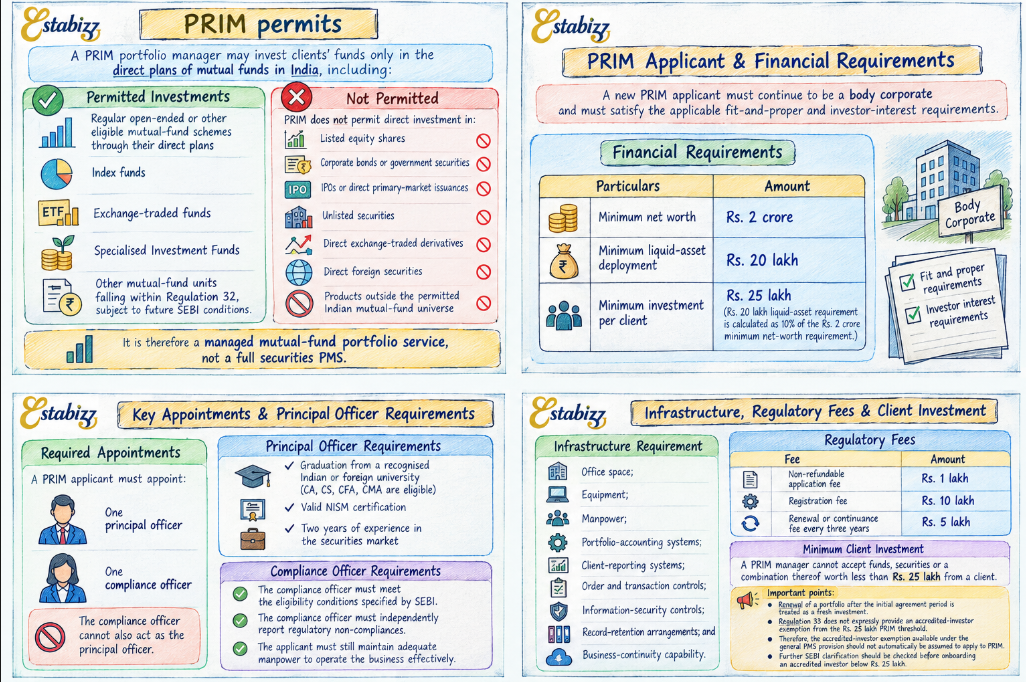
A new PRIM applicant must continue to be a body corporate and must satisfy the applicable fit-and-proper and investor-interest requirements.
An existing PMS should not start offering PRIM merely because the 2026 Regulations have been notified. Regulation 30 states that the facility is subject to conditions to be specified by SEBI.
3. Financial requirements
Requirement | PRIM | Full PMS |
Minimum net worth | Rs.2 crore | Rs.5 crore |
Minimum liquid-asset deployment | Rs.20 lakh | Rs.50 lakh |
Minimum investment per client | Rs.25 lakh | Rs.50 lakh, subject to accredited-investor exception |
The Rs.20 lakh liquid-asset requirement is calculated as 10% of the Rs.2 crore minimum net-worth requirement.
Eligible liquid assets include:
Cash;
Deposits with scheduled commercial banks;
Money-market instruments;
Government securities;
Treasury bills;
Repo on government securities;
Units of liquid mutual funds;
Units of overnight mutual funds; and
Other instruments specified by SEBI.
These assets must be unencumbered. The Rs.2 crore net worth must also be maintained separately from any capital requirement applicable to the applicant’s other regulated activities.
4. Minimum client investment
A PRIM manager cannot accept funds, securities or a combination thereof worth less than Rs.25 lakh from a client.
Important points:
Renewal of a portfolio after the initial agreement period is treated as a fresh investment.
Regulation 33 does not expressly provide an accredited-investor exemption from the Rs.25 lakh PRIM threshold.
Therefore, the accredited-investor exemption available under the general PMS provision should not automatically be assumed to apply to PRIM.
Further SEBI clarification should be checked before onboarding an accredited investor below Rs.25 lakh.
5. Principal officer requirements
The PRIM applicant must appoint a principal officer who satisfies the following:
Educational qualification
The person must possess any one of the following:
Graduation from a recognised Indian or foreign university or institution;
CFA Charter from CFA Institute, USA;
Chartered Accountant qualification;
Company Secretary qualification; or
Cost and Management Accountant qualification.
Certification
The principal officer must hold the relevant and valid NISM certification specified by SEBI.
Experience
At least two years of experience in the securities market, including experience with one or more of the following:
Portfolio manager;
Stock broker;
Investment adviser;
Research analyst;
Mutual-fund distributor; or
Fund manager.
This is materially lighter than the full PMS route, which requires five years of overall specified experience, including at least two years of relevant portfolio-management, investment-advisory or fund-management experience.
6. Compliance officer and other staffing
A PRIM applicant must appoint:
One principal officer; and
One compliance officer.
Unlike a full PMS registration, Regulation 31 does not separately require the appointment of an additional experienced employee.
However:
The compliance officer cannot also act as the principal officer.
The compliance officer must meet the eligibility conditions specified by SEBI.
The compliance officer must independently report regulatory non-compliances.
The applicant must still maintain adequate manpower to operate the business effectively.
7. Infrastructure requirement
The applicant must have adequate:
Office space;
Equipment;
Manpower;
Portfolio-accounting systems;
Client-reporting systems;
Order and transaction controls;
Information-security controls;
Record-retention arrangements; and
Business-continuity capability.
A dealing room is not expressly required under the PRIM-specific infrastructure provision. This reflects the limited mutual-fund investment universe, but final infrastructure expectations may be prescribed by SEBI.
8. Regulatory fees
The notified fee schedule appears to apply to PRIM applications because the First Schedule expressly refers to Regulation 30.
Fee | Amount |
Non-refundable application fee | Rs.1 lakh |
Registration fee | Rs.10 lakh |
Renewal or continuance fee every three years | Rs.5 lakh |
The registration fee must ordinarily be paid within 30 calendar days after SEBI communicates that the application requirements have been satisfied.
These amounts do not include expenses relating to:
Personnel;
Systems and infrastructure;
Legal and compliance support;
Auditor certification;
Custodian;
Brokers and transaction platforms;
Website and client reporting;
Cyber security; or
Continuing regulatory reporting.
9. Client agreement and Disclosure Document
The general PMS requirements continue to apply to PRIM unless specifically excluded. Before accepting a client mandate, the manager should therefore expect to:
Enter into a written investment agreement;
Define the investment approach and permitted mutual-fund universe;
Specify the investment amount and duration;
Explain fees, expenses and exit terms;
Disclose material risks;
Explain conflicts and associate investments;
Establish termination and account-settlement procedures; and
Provide the prescribed Disclosure Document.
The Disclosure Document requirements include:
Digital delivery before executing the client agreement;
Independent CA certification;
Annual updating within six months from financial year-end;
Filing of material-change addenda within 15 calendar days;
Communication of material changes to clients; and
Continuous availability of the latest version on the manager’s website.
10. Fees that PRIM may charge
A PRIM manager may charge:
Fixed management fees;
Return-linked or performance-based fees; or
A combination of fixed and performance-based fees.
However:
No return may be guaranteed or assured.
No upfront fee may be charged.
The fee range must be disclosed.
Mutual-fund investments must be made through direct plans.
The manager cannot charge the client any mutual-fund distribution-related fee.
This is an important commercial distinction: PRIM earns portfolio-management fees, not distributor commissions.
11. Client asset protection
PRIM remains a regulated PMS structure. Accordingly, the manager should expect to comply with requirements concerning:
Client-wise portfolio accounts;
Segregation of each client’s holdings;
Separation of client assets from the manager’s assets;
Separate handling of client funds;
Fiduciary responsibility;
Client-wise accounting;
Periodic client reports;
Annual audit;
Grievance redressal;
Record preservation; and
Regulatory inspection.
A custodian requirement also remains applicable unless the service falls within the advisory-only exception, subject to any PRIM-specific conditions subsequently issued by SEBI.
12. How PRIM differs from a mutual fund
PRIM is not a mutual fund or pooled investment scheme.
PRIM | Mutual fund |
Portfolio-management relationship with each client | Investors subscribe to units of a pooled scheme |
Minimum client investment of Rs.25 lakh | Scheme minimums are generally much lower |
Client-specific agreement and portfolio account | Common scheme documents and pooled portfolio |
PMS management or performance fee model | Scheme expense-ratio model |
Manager selects mutual-fund units for each client | Fund manager selects underlying securities for the pooled scheme |
Client assets and accounts remain segregated | Investors hold units representing an interest in the common scheme |
Even though PRIM invests in mutual funds, the PRIM manager must continue to manage client portfolios in a manner that does not assume the character of a mutual fund.
13. Commercial advantages
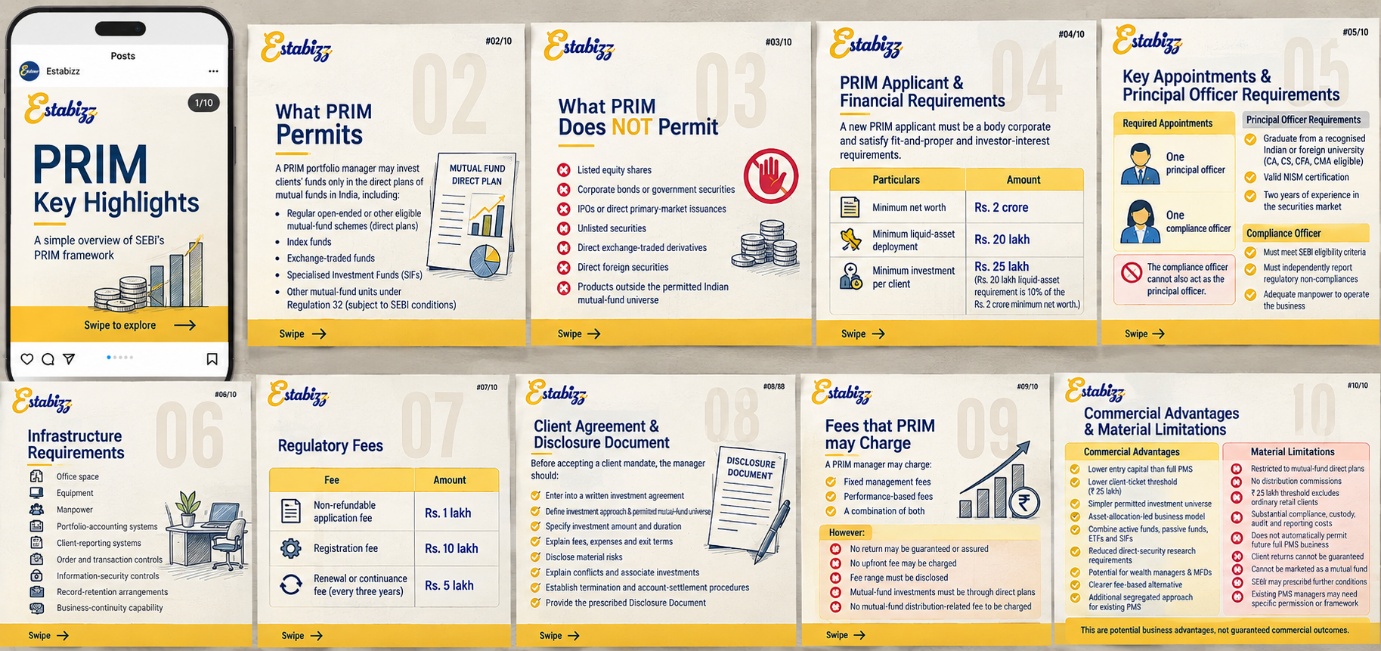
For a suitable applicant, PRIM may offer:
Lower entry capital than a full PMS;
A lower client-ticket threshold of Rs.25 lakh;
A simpler permitted investment universe;
An asset-allocation-led business model;
Ability to combine active funds, passive funds, ETFs and SIFs;
Reduced direct-security research and dealing requirements;
Potential suitability for wealth managers and mutual-fund advisory businesses moving towards regulated discretionary management;
A clearer fee-based alternative to commission-driven distribution; and
An additional segregated investment approach for an existing PMS.
These are potential business advantages, not guaranteed commercial outcomes.
14. Material limitations
PRIM also has significant constraints:
Investments are restricted to eligible mutual-fund direct plans.
Distribution commissions cannot be charged.
The Rs.25 lakh threshold excludes ordinary retail clients.
The manager must still bear substantial compliance, custody, audit and reporting costs.
A PRIM registration does not automatically permit a future full PMS business.
Client returns cannot be guaranteed.
The product cannot be marketed as a mutual fund or pooled scheme.
SEBI may prescribe further conditions concerning fees, segregation, associate investments, records and registration.
Existing PMS managers may need specific permission or compliance with a separate SEBI framework before launching PRIM.
15. Current implementation uncertainty
As of 13 October 2026, the notified Regulations provide the core PRIM framework, but I did not locate a separate official SEBI implementation circular prescribing the final:
Application form;
Portal checklist;
PRIM approval conditions;
Compliance-officer criteria;
Required policies and documents;
Investment limits involving associates;
Client-segregation mechanics;
Reporting formats;
Performance-disclosure method; or
Process for an existing PMS to add PRIM.
Accordingly, a PRIM applicant can begin eligibility assessment, capital planning, staffing and document preparation, but the final filing should be mapped to the SEBI instructions effective on the filing date.
How Estabizz Fintech Can Assist You in Obtaining SEBI PRIM Registration
Estabizz Fintech Private Limited provides end-to-end professional assistance for obtaining SEBI PRIM registration, including:
Eligibility Assessment – Corporate structure, net worth and regulatory requirements.
Documentation & Filing – Preparation and submission of SEBI registration applications.
Compliance Setup – Assistance with key personnel, infrastructure, policies and disclosure documents.
Post-Registration Support – Ongoing SEBI compliance and regulatory advisory.
From initial assessment to regulatory approval, Estabizz is your trusted compliance partner.
Registration is subject to SEBI approval and applicable regulatory requirements.
Thanks for reading
For more detail you can reacch us on info@estabizz.com
Disclaimer: This content is provided for general informational purposes only, based on the SEBI regulatory framework and updates available at the time of publication. Regulatory requirements are subject to amendments and clarifications by SEBI. Estabizz Fintech Private Limited does not guarantee regulatory approval. Readers are advised to verify the latest applicable regulations before making any business or investment decisions.
Written by
Estabizz Compliance Team
Regulatory Advisory, Estabizz Fintech
Estabizz Research Team prepares regulatory and compliance insights covering RBI, SEBI, IRDAI, IFSCA, MCA, FEMA and fintech licensing matters.
Need professional assistance? Contact the Estabizz Team at 9825600907.
Disclaimer
This article is for general informational purposes only and should not be treated as legal, regulatory, tax or financial advice. Readers should consult qualified professionals before taking any business or regulatory decision.
Need help with regulatory licensing or compliance?
Estabizz Fintech Private Limited assists businesses with RBI, SEBI, IRDAI, IFSCA, MCA, FIU-IND and allied regulatory matters.