



REGULATORY INSIGHT | SEBI PORTFOLIO MANAGEMENT SERVICES
PMS Registration and Compliance in India
A practical guide to eligibility, capital, key personnel, infrastructure, application fees, rejection risks and the responsibilities that follow SEBI registration.
Important regulatory distinction. The SEBI (Portfolio Managers) Regulations, 2026 were notified on 7 October 2026 but take effect from 1 April 2027. The thresholds and procedures described below explain that incoming framework. Applicants proposing to file before that date must follow the laws, circulars and portal requirements then in force.
For an entrepreneur entering portfolio management, registration is often viewed as the last major milestone before commencing business. In practice, the application is the beginning of a much broader responsibility. SEBI must be satisfied not only that the applicant meets the prescribed financial eligibility but also that it has suitable professionals, a credible operating model and arrangements that protect clients’ assets and information.
At Estabizz Fintech, we approach a PMS registration as the design of a regulated business. The legal entity, financial resources, management team, investment strategy and compliance framework must work together. A well-presented application cannot compensate for an operating structure that is not ready to function.
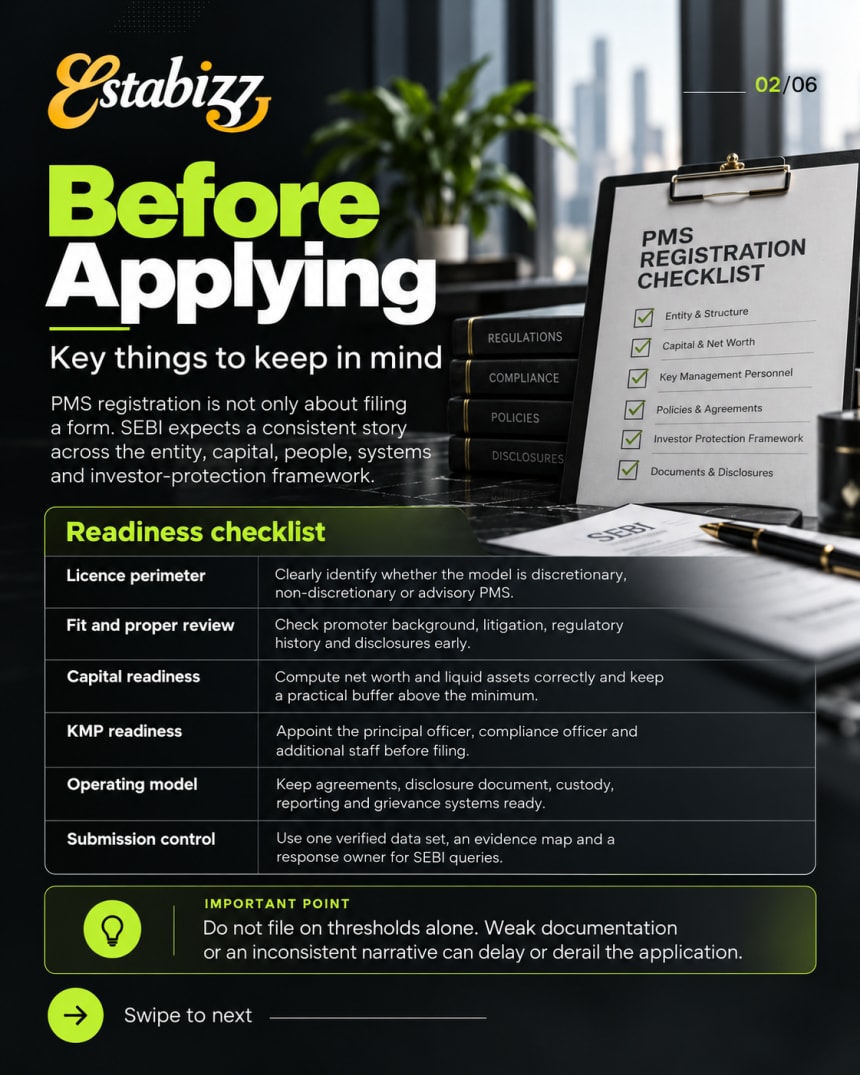
What should be considered before applying for PMS registration?
The starting point is to determine the precise nature of the proposed services. A discretionary PMS gives the manager authority to take investment decisions within the agreed mandate; a non-discretionary arrangement operates on the client’s instructions; and an advisory PMS provides investment advice within its regulatory scope. Specialised arrangements, including PRIM and co-investment activity, cannot automatically be treated in the same manner as a standard PMS registration.
Before preparation begins, promoters should review the constitutional documents, ownership and control structure, source of funds, regulatory and litigation history, appointment of officers and the proposed client segment. Corporate particulars appearing in the incorporation records, financial statements, KMP profiles and application annexures must be consistent. Even a relatively small difference in dates, capital figures or job responsibilities may require further explanation during regulatory examination.
Review area | What should be in place before filing |
Corporate readiness | Body corporate, objects and Board authority supporting the PMS activity |
Fit-and-proper assessment | Background and disclosures relating to the applicant and relevant persons |
Financial evidence | Verified net-worth computation, audited information and unencumbered liquid assets |
Personnel evidence | Appointments, experience, qualifications, certifications and reporting lines |
Operating readiness | Dealing, custody, accounting, investor reporting, risk, grievances and cybersecurity |
Estabizz perspective. The best time to identify a compliance gap is before an application fee is paid, rather than after SEBI raises an objection.
PMS eligibility criteria: capital and net-worth requirements
Under the incoming 2026 Regulations, an applicant for standard PMS registration must maintain a minimum net worth of Rs.5 crore. This is an ongoing requirement, not merely a figure to be demonstrated on the date of application. Where the entity is already carrying on another regulated activity, capital adequacy for PMS must be maintained independently of the capital applicable to that other activity.
Importantly, regulatory net worth is not necessarily the same figure described as shareholders’ funds in the balance sheet. The 2026 definition begins with paid-up equity capital, securities premium and free reserves, excluding revaluation reserves. Accumulated losses, deferred expenditure, unamortised miscellaneous expenditure and loans or advances given by the portfolio manager—including those to related parties or associates—are deducted. A certificate supported by a detailed reconciliation is therefore preferable to relying on a single balance-sheet number.
The framework further requires at least 10% of the minimum prescribed net worth to be deployed in specified unencumbered liquid assets. On the Rs.5 crore base, this works out to Rs.50 lakh. These assets may include permitted cash, deposits with scheduled commercial banks, money-market instruments, government securities, treasury bills, government-securities repos and units of eligible liquid or overnight mutual-fund schemes.
Requirement | 2026 framework | Practical implication |
Minimum regulatory net worth | Rs.5 crore | Maintain continuously |
Unencumbered liquid-asset requirement | At least Rs.50 lakh | Maintain qualifying investments and documentary evidence |
Capital for multiple regulated activities | Separate and independent | Do not assume the same capital can satisfy two separate requirements |
We recommend maintaining a reasonable buffer over the prescribed capital floor. Losses, dividends, advances, market movements and accounting adjustments can otherwise affect regulatory net worth immediately. The applicant should have a mechanism for monitoring the position after registration, with clear responsibility assigned to finance and compliance.
Key management personnel: who must be appointed?
The proposed people behind the PMS operation are central to SEBI’s assessment. Under the incoming 2026 framework, the applicant must appoint a Principal Officer, a Compliance Officer and at least one additional eligible employee. These are substantive appointments; merely assigning designations to individuals who cannot demonstrate relevant work experience or exercise their responsibilities is insufficient.
Principal Officer
The Principal Officer must meet the prescribed educational qualification: graduation from a recognised Indian or foreign university, or an eligible professional qualification such as CA, CS, Cost and Management Accountant or CFA Charter. The person must obtain and maintain the relevant NISM certification specified by SEBI. The experience requirement is at least five years in related securities-market activities, including at least two years in portfolio management, investment advisory or fund-management-related areas. The Principal Officer is an employee and carries responsibility for investment decision-making and the other operations of the PMS.
Compliance Officer and additional employee
The Compliance Officer must satisfy SEBI’s applicable eligibility criteria and be capable of monitoring regulatory compliance, dealing with investor grievances and reporting non-compliance independently. Under the general 2026 provisions, this function cannot be combined with the roles of Principal Officer or the specifically required additional employee. The additional employee must be a graduate with at least two years of relevant securities-market experience. Any other employee or independent fund manager entrusted with fund-management decisions must meet the Principal Officer’s applicable qualification, experience and certification standards.
Role | Qualification / certification | Experience or responsibility |
Principal Officer | Eligible degree / professional qualification, relevant NISM certification | 5 years related securities-market work; 2 years in specified PMS/advisory/fund-management areas |
Compliance Officer | As prescribed by SEBI | Independent compliance monitoring and reporting |
Additional employee | Recognised graduate | 2 years related securities-market experience |
Other fund decision-maker | Same prescribed minimum standard as Principal Officer | Applicable where the person exercises fund-management decision authority |
As a practical measure, applicants should prepare a documented experience matrix supported by appointment letters, service records, detailed work profiles and certification evidence. Job titles alone do not demonstrate the nature of work performed. Overlapping periods should be reconciled and each person’s actual reporting line should be explained.
Infrastructure requirements for PMS registration
An applicant must have adequate office space, equipment, a dealing room and manpower to conduct portfolio management effectively, subject to any category-specific dealing-room exception specified by SEBI. These requirements reflect operational substance. A presentable office is valuable, but SEBI’s consideration extends to whether investment instructions, client assets, accounting and compliance activities can be handled reliably.
The operational setup should include suitable portfolio accounting and client reporting systems, trade controls, maker-checker approvals, books and records, information-security safeguards and business-continuity arrangements. Separate handling of client money and holdings, reconciliation processes, custody arrangements wherever required and a functioning grievance framework also deserve attention. Some of these are broader operating and post-registration obligations rather than items expressly listed in the infrastructure eligibility clause; they must be tailored to the chosen PMS model.
Infrastructure area | Evidence Estabizz recommends preparing |
Premises and dealing | Lawful office occupancy, adequate personnel and dealing-room arrangements where applicable |
Investment operations | Order execution, trade allocation, investment-limit checks and decision records |
Systems and technology | Portfolio accounts, client statements, access controls, backup and audit trail |
Investor protection | Client segregation, reconciliation, custodian interface and grievance response |
Business continuity | Incident response, disaster recovery, outsourcing oversight and secure records |
During the preparation stage, our emphasis is on practical demonstrations: screenshots of systems, sample reports, tested reconciliations, segregation-of-duties charts, signed arrangements and walkthroughs. Draft policies are helpful, but working controls are more persuasive than future promises.
PMS registration process, application fees and approval
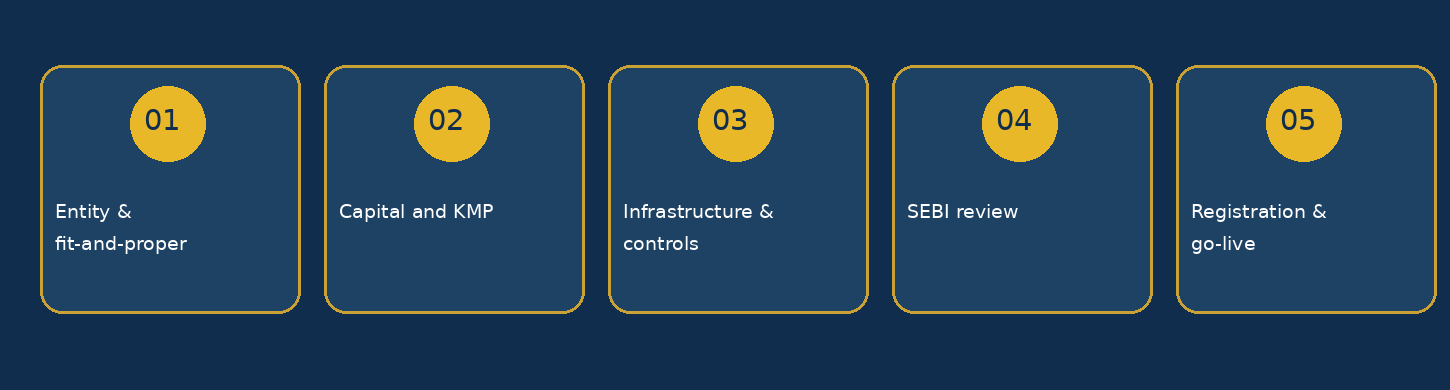
The registration journey begins with an application in the form prescribed by SEBI, supported by appropriate documents and the non-refundable application fee. SEBI may then seek clarifications or additional information. Where the application is incomplete, the regulator must provide an opportunity to cure specified deficiencies, with a period of at least 30 calendar days before rejection on that ground. Once SEBI is satisfied about the relevant eligibility requirements, the applicant receives an intimation and must pay the registration fee within the prescribed period. A certificate may then be issued.
Fee | Amount under 2026 framework | When payable |
Application fee | Rs.1 lakh | Non-refundable; payable with the application |
Registration fee | Rs.10 lakh | Within 30 calendar days of SEBI intimation |
Continuation fee | Rs.5 lakh | For each three-year block, paid within the prescribed pre-expiry window |
The registration fee and continuation obligations must be distinguished from the separate professional, technology, office and operational expenditure required to establish the business. SEBI does not prescribe a fixed time within which every complete application will be approved; query cycles, documentation and regulatory examination may influence the actual period.
When can a PMS application be rejected or refused?
A common misconception is that possession of Rs.5 crore in capital makes registration almost automatic. The regulator considers multiple eligibility aspects, including fit-and-proper status, personnel suitability, infrastructure and investor interest. An incomplete application may be rejected after the specified opportunity to cure deficiencies. Separately, SEBI may refuse a certificate after giving the applicant a reasonable opportunity of being heard.
Possible concern | Preventive approach |
Incomplete documents | Reconcile every declaration with its supporting attachment |
Unsubstantiated KMP experience | Check actual functions, appointment periods and qualifications |
Incorrect net-worth certificate | Use the prescribed computation and trace deductions |
Weak operational evidence | Demonstrate functioning systems and independent controls |
Incomplete adverse disclosures | Provide full and accurate regulatory and litigation history |
Unresolved SEBI queries | Maintain a single authorised, evidence-backed response record |
Under the incoming Regulations, a refusal must be communicated with reasons within 30 days of refusal. The applicant may seek reconsideration within 30 days of receiving the communication. There is no responsible way to quote a standard probability of approval or rejection because the outcome depends on the applicant’s actual facts, documents and regulatory assessment.
What does the company receive after registration?
Following the prescribed process, SEBI may grant a Certificate of Registration permitting the body corporate to operate as a portfolio manager within the approved regulatory scope. The certificate remains valid unless suspended or cancelled, subject to compliance with continuing conditions and payment of the relevant continuation fees. Registration may be accurately communicated to clients, but should never be described as an endorsement by SEBI of investment returns or commercial prospects.
Approval is not a substitute for a go-live review. Before accepting client mandates, the manager should finalise the investment agreement, certified disclosure document, custody and banking arrangements, client-wise records, website disclosures, grievance channels, staff authorisations and regulatory calendar. The incoming framework also requires commencement of business within three years, subject to the relevant SEBI conditions.
Post-registration compliance: where the real responsibility begins
A registered portfolio manager operates in a fiduciary capacity. Client onboarding should follow the required KYC and anti-money-laundering controls, written agreements and prescribed disclosures. Under the general 2026 PMS framework, the minimum client investment is Rs.50 lakh, subject to the applicable accredited-investor exception. Fees must be properly disclosed; upfront fees and assured-return representations are prohibited.
The manager must maintain client-wise segregation of assets and appropriate handling of client funds, appoint a custodian where required, comply with investment restrictions and conflict controls and preserve the records supporting investment decisions. Investment performance, fees, related-party dealings and advertising must follow the applicable SEBI requirements. Investor complaints require prompt attention, including the prescribed 21-calendar-day grievance period under the incoming framework.
Timing / trigger | Important compliance action |
Continuous | Net worth, qualifying liquid assets, KMP, controls, custody, segregation and fit-and-proper status |
Each client onboarding | KYC/AML, disclosure document, written agreement, client eligibility and fee explanation |
Periodic / quarterly | Client reports at intervals not exceeding three months and applicable regulatory reporting |
Annual / financial-year cycle | Audits, compliance review and updated, independently certified disclosure document |
Upon material change | Prescribed filing of addenda, client communication and SEBI notification |
Complaints and findings | Investor grievance tracking, auditor observation remediation and evidence retention |
Every three-year fee block | Pay the prescribed continuation fee within the pre-expiry window |
The 2026 Regulations describe annual updating and independent certification of the disclosure document, specified reporting and record-preservation duties, including a minimum five-year period for prescribed books and records. The exact filing formats, industry submissions and additional timelines must always be read with the SEBI Master Circular and any later instructions applicable on the relevant date.
How Estabizz Fintech supports PMS applicants and registered managers
At Estabizz Fintech, our role begins with understanding the business the promoters wish to build. We review the proposed investment services, entity structure, regulatory eligibility and documentation gaps before mapping a realistic route to registration. We then assist in coordinating the net-worth and KMP evidence, operating policies, business plan, application annexures and regulatory responses, working with the client’s authorised directors, finance team and professional advisers.
Once a certificate is received, we can support the transition from registration to daily compliance through a tailored calendar, document templates, disclosure reviews, reporting coordination, grievance registers and periodic checks on key controls. The objective is not merely to secure a licence, but to help establish an organisation that is capable of maintaining the standards expected of a regulated portfolio manager.
PMS registration is best approached with clarity before filing and discipline after approval. Capital opens the door; the quality of governance, professionals and investor protection sustains the business.
Disclaimer: This content is intended for general information and educational purposes only, based on applicable SEBI regulations. Regulatory requirements may change from time to time. PMS registration is subject to SEBI's eligibility criteria, assessment and approval. Estabizz Fintech does not guarantee regulatory approval or investment returns. Readers are advised to seek professional guidance before making any business or investment decisions.
Written by
Estabizz Compliance Team
Regulatory Advisory, Estabizz Fintech
The Estabizz Compliance Team comprises regulatory advisers with extensive experience across RBI, SEBI, IRDAI and IFSCA frameworks.
Need professional assistance? Contact the Estabizz Team at 9825600907.
Disclaimer
This article is for general informational purposes only and should not be treated as legal, regulatory, tax or financial advice. Readers should consult qualified professionals before taking any business or regulatory decision.
Planning a SEBI Registration?
Support for PMS, AIF, RIA, research analyst and intermediary registrations: eligibility, net worth, documentation and ongoing SEBI compliance.
