What is RTA Registration in India?
RTA Registration in India is the statutory approval granted by the Securities and Exchange Board of India (SEBI) to a body corporate intending to act as a Registrar to an Issue or Share Transfer Agent. It permits the registered entity to handle activities such as public issue application processing, allotment-related functions, investor records, shareholder service requests, securities transfer documentation, corporate action coordination and investor grievance redressal.
The SEBI RTA Regulations, 2025 and Master Circular dated 06 February 2026 have strengthened expectations around governance, cyber resilience, investor service portals, grievance redressal, capacity discipline, office approvals, internal controls and senior management accountability. Therefore, RTA Registration in India should be approached as an institutional approval, not a routine filing exercise.
RTAs are important capital market intermediaries because they interface with issuers, investors, stock exchanges, depositories and regulatory platforms. Any error or delay in RTA operations may directly affect investor rights, listing timelines, corporate action execution and market confidence.
No entity should act as Registrar to an Issue or Share Transfer Agent for listed securities without valid SEBI registration. Unregistered activity may attract regulatory and enforcement action.
Legal Background of RTA Registration in India
- Regulator — Securities and Exchange Board of India
- Primary Regulation — SEBI Registrars to an Issue and Share Transfer Agents Regulations, 2025, as amended from time to time
- Master Circular — SEBI Master Circular for Registrars to an Issue and Share Transfer Agents dated 06 February 2026
- Applicable Law — SEBI Act, 1992
- Intermediary Framework — SEBI Intermediaries Regulations, 2008, where applicable
- Application Form — Form A
- Core Regulatory Focus — Investor record accuracy, issue processing, grievance redressal, net worth, governance, cyber resilience, capacity discipline, online investor services and inspection readiness
- Regulatory Powers — Registration, supervision, inspection, suspension, cancellation and penalties
The 2026 Master Circular consolidates operational and compliance directions applicable to RTAs. It reflects SEBI's preventive supervision approach and strengthens expectations around digital investor services, cyber resilience, governance accountability and timely complaint resolution.
What is a Registrar to an Issue and Share Transfer Agent?
A Registrar to an Issue and Share Transfer Agent is a SEBI-registered intermediary that provides issuer and investor-facing services in relation to public issues, rights issues, share transfers, investor records, corporate actions and securities-related service requests.
Core RTA activities include: • Processing public issue applications • Finalising basis of allotment support • Refund and allotment coordination • Maintaining register of members • Handling transfer and transmission requests • Processing duplicate certificate requests • Supporting demat corporate actions • Handling dividend / refund-related records • Investor grievance redressal • Coordination with stock exchanges and depositories
RTA activity requires high accuracy, data confidentiality and process discipline because investor records and capital market transactions are highly sensitive.
Why RTA Registration in India is Mandatory
Without SEBI RTA Registration: • Entity cannot act as Registrar to an Issue • Entity cannot act as Share Transfer Agent for listed securities • Public issue processing activity may be treated as unauthorised • Investor grievance handling may lack regulatory accountability • Issuer and investor trust may be affected • SEBI enforcement risk may arise
With SEBI RTA Registration: • Legal authority to undertake RTA activities • Recognition as SEBI-registered intermediary • Credibility with listed entities, issuers and capital market participants • Structured investor grievance framework • Regulatory clarity on records, IT systems and governance • Institutional discipline under SEBI supervision
SEBI RTA Regulations 2025 and Master Circular 2026
The SEBI RTA Regulations, 2025 and Master Circular dated 06 February 2026 represent a strengthened regulatory framework for RTAs. The focus has shifted from basic registration to continuous institutional readiness.
Key evolution areas: • Governance — From basic compliance framework to senior management accountability • Net Worth — From financial threshold to continuous ₹50 lakh net worth discipline • Cyber Security — From operational requirement to mandatory cyber security and cyber resilience framework • Investor Services — From manual / basic complaint process to online investor service portal with tracking discipline • Grievance Redressal — Strict 21 calendar day resolution discipline • Office Control — Operations from approved offices; shifting / closure requires approval • Capacity — Explicit capacity discipline and no disproportionate work acceptance • Outsourcing — Substantial outsourcing of core activity restricted • Record Retention — Minimum 8 years with audit trail and digital integrity • Inspection — Continuous inspection readiness and supervisory monitoring
This evolution reflects SEBI's movement toward preventive supervision, data security and investor service transparency.
Who Needs RTA Registration in India?
- Acting as Registrar to an Issue — Required
- Processing public issue applications — Required
- Finalising allotment-related records — Required
- Maintaining investor / shareholder records for listed securities — Required
- Handling share transfer agency for listed securities — Required
- Processing investor service requests for listed securities — Required
- Corporate action support for listed securities — Required where activity falls under RTA framework
- Unlisted company registry services — Separate structuring required; listed securities activity requires SEBI RTA registration
If a business proposes to provide RTA services to listed companies, issuers or public market transactions, registration must be obtained before operations.
Who Cannot Apply for RTA Registration in India?
- Individual — Not eligible
- Partnership Firm — Not eligible
- LLP — Not eligible as per uploaded source content
- Entity not incorporated as body corporate — Not eligible
- Entity failing fit and proper criteria — Registration risk
- Entity without ₹50 lakh net worth — Not eligible until rectified
- Entity without proper office and IT systems — Application deficiency
- Entity without compliance officer — Application deficiency
- Entity proposing substantial outsourcing of core RTA functions — Regulatory concern
- Entity intending to operate from unapproved offices — Not permitted
Only a body corporate meeting SEBI's eligibility, governance, financial and infrastructure requirements should proceed with RTA Registration in India.
Eligibility Criteria for RTA Registration in India
- Legal Structure — Body corporate
- Minimum Net Worth — ₹50 lakh
- Fit and Proper Status — Promoters, directors and key persons must qualify
- Infrastructure — Adequate office premises, IT systems and data security
- Office Approval — Operations only from declared and approved offices
- Compliance Officer — Mandatory appointment
- Audit Committee — Governance oversight mechanism expected
- Investor Service Portal — Online service request and tracking capability expected
- Cyber Security — SEBI Cyber Security and Cyber Resilience Framework compliance
- Record Retention — Minimum 8 years
- Capacity Discipline — Must not accept work disproportionate to operational capacity
- Internal Controls — SOPs, grievance mechanism and control documentation required
Net Worth Requirement for RTA Registration in India
The prescribed minimum net worth for RTA Registration in India is ₹50 lakh. Net worth must be maintained continuously and should not be treated as a one-time application-stage requirement.
Net Worth Formula: Net Worth = Paid-up Capital + Free Reserves + Securities Premium − Accumulated Losses − Intangible Assets − Non-Qualifying Items
Component treatment: • Paid-up Equity Capital — Included • Free Reserves — Included • Securities Premium — Included as per source content • Accumulated Losses — Deducted • Intangible Assets — Deducted • Borrowed Funds — Not a substitute for net worth • Revaluation Reserves — Avoid treating as free reserves for conservative calculation
Quarterly internal net worth monitoring is advisable. Any erosion in net worth should be immediately reviewed, documented and rectified to avoid regulatory scrutiny.
Infrastructure and Office Requirement
- Adequate office premises
- SEBI-declared and approved office location
- No office shifting without prior approval
- Proper custody of stationery and security instruments
- Secure investor records storage
- Dedicated compliance and grievance desk
- Sufficient manpower for assignment capacity
- IT systems and investor request workflow
- Document scanning and archival process
- Disaster recovery and backup system
The uploaded quote refers to adequate office space of minimum 1200 sq. ft. Verify the latest SEBI / application-level requirement before treating this area threshold as a fixed rule.
Cyber Security and IT Framework
The 2026 Master Circular strengthens IT governance and cyber resilience expectations for RTAs. Since RTAs handle sensitive investor data and high-volume capital market records, cyber security is now a core regulatory expectation.
- Cyber Security Framework — Implement SEBI Cyber Security and Cyber Resilience Framework
- Data Protection — Protect investor, issuer and transaction data
- Sensitive Data Location — Comply with regulatory expectation on Indian jurisdiction / data localisation where applicable
- Access Control — Role-based access and maker-checker controls
- Audit Logs — Maintain complete system trails
- Incident Reporting — Cyber incident reporting and escalation protocol
- Backup and DR — Disaster recovery and business continuity arrangements
- SaaS / Vendor Review — Evaluate GRC / SaaS tools carefully before use
- Periodic Audit — Cyber / system audit as applicable
Data protection and cyber discipline should be built before applying. A weak IT framework may affect both registration and post-registration inspection outcomes.
Mandatory Online Investor Service Portal
The 2026 Master Circular expects a stronger digital investor service mechanism. RTAs should maintain an online portal through which investors can submit and track service requests transparently.
Portal capability checklist: • Investor login with OTP authentication • Online submission of service requests • Document upload facility • Unique Reference Number (URN) generation • SMS and email alerts at each stage • Request status tracking • Closure workflow • Escalation matrix • Record retention and audit trail • Closure of requests pending physical documents beyond 30 days, where applicable
Process Flow: Investor Login → Service Request Submission → Document Upload → URN Generation → RTA Processing → SMS / Email Updates → Resolution / Closure → Record Retention
Investor Grievance Redressal under RTA Registration in India
Investor grievance handling is one of the most critical compliance obligations of an RTA. Complaints must be properly acknowledged, tracked, resolved and documented.
- Resolution Timeline — Within 21 calendar days
- SCORES Monitoring — Mandatory monitoring and response
- Action Taken Report — Proper ATR submission required
- Complaint Register — Maintain updated grievance register
- Closure Discipline — Complaint should not be closed without actual resolution
- Escalation Matrix — Internal escalation for delayed cases
- Management Review — Periodic review by compliance officer / audit committee
Delayed investor complaint resolution may lead to regulatory observation, inspection or enforcement action.
Segregation of Listed and Unlisted Services
The 2025 framework strengthens segregation expectations where an RTA provides services to unlisted entities alongside listed securities-related work.
- Listed Securities Services — Must comply fully with SEBI RTA framework
- Unlisted Company Services — Should be separately identified and ring-fenced
- Separate Business Unit — Required as per uploaded quote / source framework
- Data Segregation — Listed investor data should not be mixed or misused
- Operational Segregation — Staff, systems or workflows should be clearly documented
- Conflict Control — Avoid preferential treatment or misuse of information
- Audit Trail — Maintain records showing segregation
Segregation reduces conflict and prevents misuse of investor data. This is a key 2026 compliance expectation.
Capacity Discipline and Outsourcing Restrictions
RTAs must not accept assignments beyond operational capacity. Overloading RTA systems can affect IPO timelines, investor service quality, allotment accuracy and complaint resolution.
- Issue Handling Capacity — Must match manpower, IT and workflow capacity
- Manpower Adequacy — Sufficient trained staff required
- IT Load Capacity — Systems must handle assignment volume
- Assignment Acceptance — No disproportionate work acceptance
- Substantial Outsourcing — Restricted for core RTA activities
- Vendor Engagement — Must be controlled, documented and supervised
- Service Quality — Investor service timelines must be protected
SEBI may examine whether system failure, investor delay or complaint backlog is linked to capacity mismanagement.
Compliance Officer, Audit Committee and Governance Framework
- Compliance Officer — Mandatory appointment
- Audit Committee — Governance oversight expected
- CEO / Senior Management Accountability — Strengthened under 2025 / 2026 framework
- Internal Control Manual — Required for process discipline
- Whistleblower Policy — Recommended / expected governance control
- Conflict of Interest Policy — Required for investor data protection and impartiality
- Grievance SOP — Mandatory process document
- Cyber Security Policy — Required
- Board Review — Periodic review of compliance and risk
Governance Flow: Board of Directors → Audit Committee → CEO / Senior Management → Compliance Officer → Operations, Investor Services and IT Teams → Investor Request and Complaint Handling
Documents Required for RTA Registration in India
- Application Documents — Form A, application fee proof and SEBI-prescribed declarations
- Corporate Documents — Certificate of Incorporation, MOA, AOA, PAN and registered office proof
- Board Documents — Board resolution approving RTA Registration application and compliance officer appointment
- Financial Documents — CA-certified net worth certificate, audited financial statements, bank statements and capital proof
- Promoter / Director Documents — KYC, PAN, address proof, fit and proper declarations, DIN details and litigation disclosures
- Compliance Documents — Compliance officer appointment proof, internal control manual, grievance redressal SOP and conflict policy
- Infrastructure Documents — Office proof, office layout, infrastructure details and approved office readiness note
- IT Documents — Cyber security policy, IT architecture, data protection framework, BCP / DR note and audit trail process
- Investor Portal Documents — Portal screenshots / flow, URN mechanism, OTP login process and request tracking workflow
- Business Plan — 3-year revenue, cost, staffing, IT, compliance and assignment capacity plan
- Governance Documents — Audit committee details, whistleblower mechanism, escalation matrix and capacity control framework
Step-by-Step Process for RTA Registration in India
Step 1 — Eligibility and Net Worth Assessment: Review body corporate status, promoter profile, net worth readiness, fit and proper position and regulatory suitability.
Step 2 — Governance and Compliance Structuring: Appoint compliance officer, structure audit committee oversight, prepare internal control documentation and grievance framework.
Step 3 — Infrastructure and IT Readiness: Prepare office infrastructure, investor service portal, cyber security framework, record retention system and operational SOPs.
Step 4 — Business Plan and Capacity Planning: Prepare 3-year business plan covering issue-handling capacity, staffing, IT investment, revenue model and compliance cost.
Step 5 — Form A Filing with SEBI: Submit application in prescribed Form A with documents and non-refundable application fee.
Step 6 — SEBI Scrutiny and Clarifications: SEBI reviews eligibility, net worth, infrastructure, governance, IT systems, compliance officer details and operational readiness.
Step 7 — Regulatory Query Response: Respond to SEBI clarifications with proper supporting documents, revised submissions and explanations.
Step 8 — Registration Fee Payment: Upon SEBI satisfaction, pay prescribed registration fee through approved mode.
Step 9 — Certificate Issuance: SEBI issues RTA registration certificate, subject to ongoing compliance.
Step 10 — Post-Registration Compliance Setup: Activate investor service portal, complaint tracking, SCORES monitoring, cyber audit, record retention and compliance calendar.
Government Fees for RTA Registration in India
- Application Fee — ₹25,000 as per uploaded quote; verify latest SEBI schedule
- Registration Fee — ₹6,00,000 as per uploaded quote; verify latest SEBI schedule
- Periodic Fees — As prescribed by SEBI
- Mode of Payment — Directly through SEBI / regulatory portal or prescribed payment mode
- Refundability — Application fee generally non-refundable
Fees must be verified from the latest SEBI RTA Regulations, fee schedule and portal instructions before filing or hardcoding in reusable website data.
Timeline for RTA Registration in India
- Eligibility and net worth assessment — 1 to 2 weeks
- Documentation and structuring — 3 to 4 weeks
- SEBI review — 6 to 10 weeks
- Clarification round — Depends on query complexity
- Final approval and fee payment — Post SEBI satisfaction
- Overall timeline — Generally 3 to 4 months or more depending on readiness and SEBI review
Timeline is indicative and depends on documentation quality, SEBI scrutiny, net worth readiness, cyber security framework, investor portal readiness, office infrastructure and query response.
Post-Registration Compliance for RTAs
- Net Worth Maintenance — Maintain minimum ₹50 lakh continuously
- Investor Complaint Resolution — Within 21 calendar days
- SCORES Monitoring — Daily / regular monitoring and ATR submission
- Record Retention — Minimum 8 years
- Cyber Security — Continuous cyber resilience compliance
- Investor Portal — Maintain online request tracking mechanism
- Office Approval — Operate only from approved offices
- Capacity Control — Do not accept work beyond operational capacity
- Internal Controls — Maintain SOPs and control documentation
- Audit Committee Review — Periodic governance oversight
- Investor Charter — Publish and update as required
- Regulatory Reporting — Submit reports / information as prescribed
RTA Registration in India – Compliance Calendar
Continuous Compliance: • Minimum Net Worth — Continuous — CFO / Board — Suspension risk if missed • Investor Grievance Resolution — Continuous — Compliance Officer / Investor Desk — Regulatory observation • SCORES Monitoring — Daily / continuous — Compliance Team — Complaint escalation • Cyber Security Monitoring — Continuous — IT Head / CISO — Enforcement risk • Record Retention — Continuous — Operations — Inspection finding • Approved Office Control — Continuous — Compliance Officer — Regulatory action • Capacity Discipline — Continuous — Senior Management — Operational violation
Quarterly Compliance: • Net Worth Review — CFO • Complaint Review — Compliance Officer • SCORES Status Review — Investor Service Team • Cyber Log Review — IT Team • Capacity Review — Operations Head • Audit Committee Update — Company Secretary / Compliance
Half-Yearly / Periodic Compliance: • Internal Control Testing — Internal Audit / Compliance • IT System Review — IT Head • Investor Portal Review — Operations / IT • Investor Charter Review — Compliance Officer • Vendor Review — IT / Legal
Annual Compliance: • Audited Financial Statements — Submit / maintain as prescribed • Net Worth Certificate — CA-certified annual confirmation • Internal Audit / System Audit — Conduct as applicable • Cyber Security Audit — As per SEBI cyber framework • Policy Review — Grievance, cyber, whistleblower, conflict and internal control policies • Audit Committee Review — Annual governance and compliance status review • Record Retention Audit — Verify 8-year retention and digital backup
Event-Based Compliance: • Change in Control — Prior SEBI approval required • Change in Directors / Key Persons — Intimation / approval as applicable • Office Shift / Closure — Prior SEBI approval required • Merger / Acquisition — Regulatory approval / disclosure required • Cyber Incident — Immediate escalation and reporting as per framework • Net Worth Erosion — Immediate review and restoration • Investor Portal Failure — Incident recording and corrective action • Voluntary Surrender — Follow SEBI surrender process • High Complaint Backlog — Internal escalation and corrective plan
Investor Charter and Service Standards
RTAs must maintain transparent service standards and investor-facing disclosures. The investor charter helps investors understand service timelines, rights, complaint channels and escalation mechanisms.
Investor Charter elements: • Services offered by RTA • Investor rights • Service request timelines • Complaint resolution timeline • Escalation matrix • SCORES reference • Contact details • Online request tracking • Documents required for investor requests • Service standards publication on website
Investor Charter should be easily accessible on the RTA website and aligned with SEBI requirements.
Record Retention and Stationery Control
- Issue Records — Preserve for minimum 8 years
- Investor Service Requests — Preserve with audit trail
- Complaint Register — Maintain resolution records
- Financial Records — Preserve as per law and SEBI framework
- Transfer Documents — Maintain securely
- Refund / Dividend Records — Control and reconcile
- Pre-Printed Certificates — Secure custody and control
- Stationery Instruments — Controlled issuance and reconciliation
- Digital Records — Backup, integrity and retrievability
- Audit Logs — Maintain system-level trail
Physical and digital controls are equally important because RTAs handle sensitive instruments, records and investor identity documents.
SEBI Inspection and Enforcement Powers
SEBI may inspect books, records, IT systems, electronic logs, grievance handling, net worth compliance, investor portal, office approvals, internal controls and cyber security framework.
Inspection readiness areas: • Registration Certificate — SEBI certificate and correspondence • Net Worth Records — CA certificate, financial statements and capital records • Complaint Register — Complaint status and closure evidence • SCORES Records — ATRs, complaint logs and closure details • Investor Portal Logs — URN tracking and service request records • Cyber Security Records — Policies, audit reports, incident logs and access controls • Office Approval Records — SEBI approvals and office details • Audit Committee Minutes — Compliance review records • Internal Control Manual — SOPs and control testing reports • Record Retention Proof — Archive and backup evidence • Capacity Review Notes — Workload and manpower analysis
Suspension, Cancellation and Penalties
- Net worth deficiency — Suspension / corrective action
- Delayed grievance resolution — Inspection observation / penalty
- Cyber security lapse — Enforcement risk
- Unauthorised office operation — Regulatory action
- Regulatory misreporting — Penalty / suspension
- Data misuse — Serious enforcement action
- Substantial outsourcing of core activity — Regulatory concern
- Accepting work beyond capacity — Supervisory action
- Failure to maintain records — Inspection adverse finding
- Non-cooperation during inspection — Serious regulatory action
- False information in application — Cancellation risk
- Operating without registration — Enforcement under SEBI Act
SEBI may suspend or cancel registration and may impose monetary penalties depending on the nature, seriousness and repetition of violations.
Enforcement Risk Mapping for RTA Registration in India
- Net Worth Drop — Suspension risk — Mitigation: Quarterly internal monitoring and capital buffer
- IT Security Breach — Inspection and penalty risk — Mitigation: Cyber audit, SOC controls and incident response plan
- Delayed Grievance Resolution — Investor escalation and SEBI scrutiny — Mitigation: Dedicated grievance team and 21-day tracker
- Unapproved Office Shift — Regulatory action — Mitigation: Prior SEBI approval and office register
- Excess Issue Handling — Operational violation — Mitigation: Capacity planning and assignment approval matrix
- Investor Data Misuse — Severe enforcement risk — Mitigation: Data access control and confidentiality policy
- Poor Record Retention — Inspection finding — Mitigation: Digital archive and audit trail
- SCORES Delay — Regulatory observation — Mitigation: Daily portal monitoring
Common Mistakes in RTA Registration in India
- Applying without body corporate eligibility — Application not maintainable
- Weak net worth certificate — SEBI query
- No investor portal readiness — Application / compliance concern
- Poor cyber security documentation — SEBI scrutiny
- No grievance tracking mechanism — Post-registration risk
- No capacity planning — Operational violation
- Operating from unapproved office — Regulatory action
- Underestimating staffing requirement — Service failure risk
- No segregation of unlisted services — Conflict and data misuse risk
- Copy-paste internal control manual — Weak regulatory presentation
- No audit committee oversight — Governance concern
- Delayed SEBI query response — Approval delay
Strategic Structuring Recommendations Before Applying
- Confirm body corporate structure
- Maintain ₹50 lakh net worth with clean CA certification
- Prepare promoter and director fit and proper documentation
- Appoint compliance officer before filing
- Structure audit committee and governance oversight
- Prepare cyber security and cyber resilience policy
- Build online investor service portal with URN tracking
- Prepare grievance redressal SOP with 21-day closure tracker
- Prepare record retention and digital archive framework
- Prepare capacity assessment model
- Avoid core activity outsourcing without proper regulatory review
- Ensure office premises are ready and declared
- Prepare for SEBI inspection from day one
"A registration granted by a regulator is not an operational licence alone. It is a statement that your systems are mature enough to safeguard investor trust." — CS Devyani Khambhati – Compliance Expert
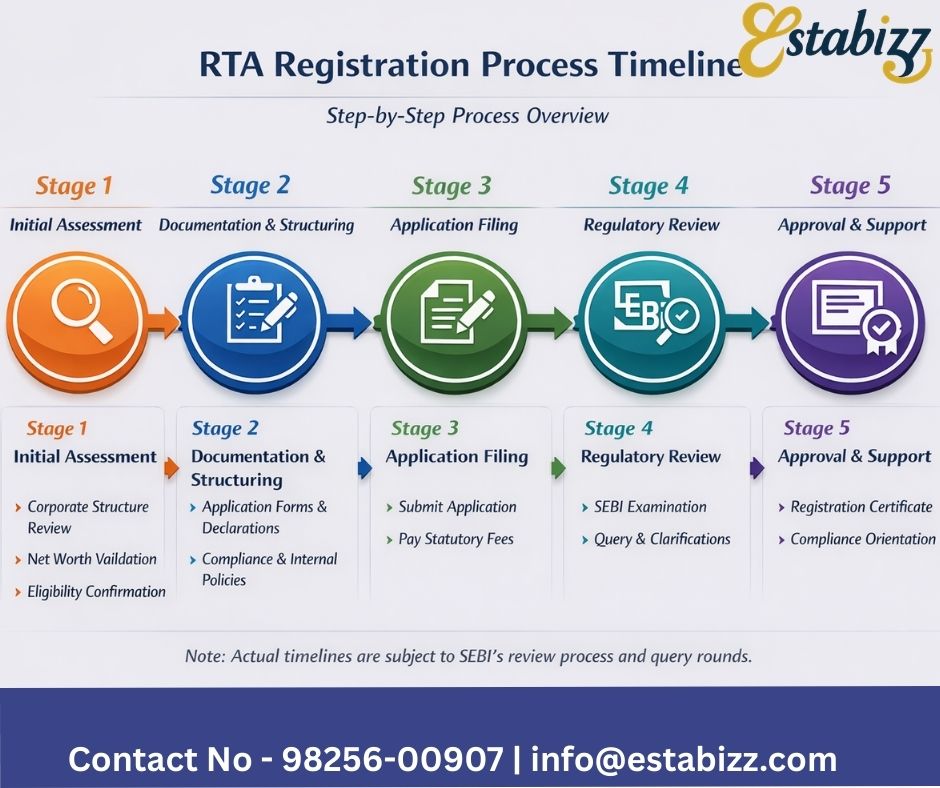
RTA Registration Process Timeline – Visual Reference
The following timeline summarises the indicative stages of an RTA Registration application — from initial assessment and documentation to SEBI review, query handling and certificate issuance. Actual duration depends on documentation quality, SEBI scrutiny and clarification rounds.
RTA Registration Process Flowchart – End-to-End Framework
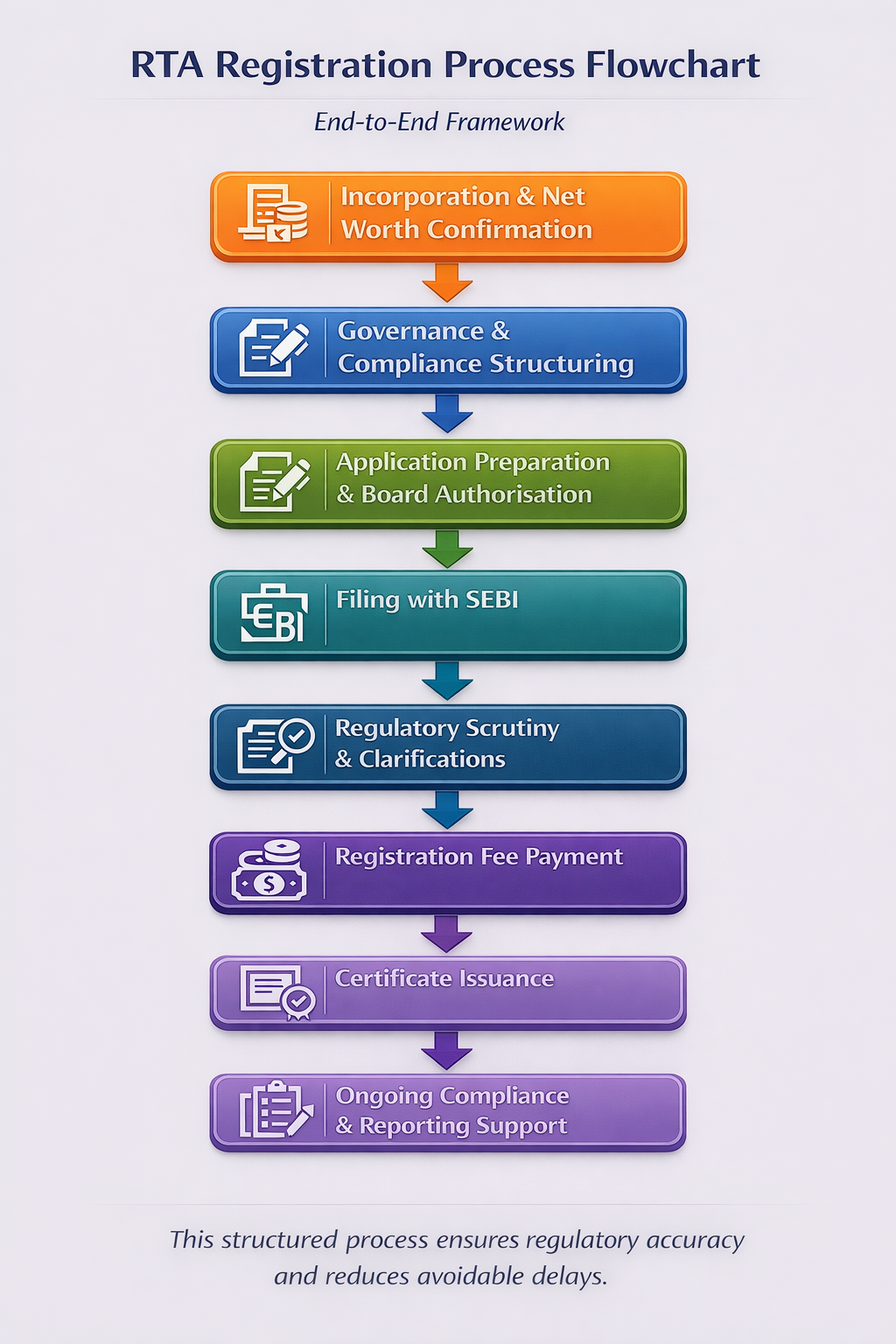
The RTA Registration process moves from incorporation and net worth confirmation to governance structuring, application preparation, SEBI filing, regulatory scrutiny, fee payment, certificate issuance and ongoing compliance support.
Frequently Asked Questions on RTA Registration in India
General Overview
What is RTA Registration in India?
Which regulation governs RTA Registration in India?
What is the relevance of the SEBI Master Circular dated 06 February 2026?
Is RTA Registration mandatory?
Who regulates RTAs in India?
Eligibility
Who can apply for RTA Registration in India?
Can an individual apply for RTA Registration?
Can an LLP apply for RTA Registration?
Can a partnership firm apply?
Net Worth & Capital
What is the minimum net worth required?
Is net worth required only at application stage?
Is CA-certified net worth certificate required?
Activities & Capacity
What activities are covered under RTA Registration?
Can an RTA serve multiple issuers?
Can RTA accept unlimited IPO assignments?
Can RTA outsource core activities?
Governance & Cyber Security
Is compliance officer appointment mandatory?
Is audit committee oversight required?
Is cyber security compliance mandatory?
Is investor service portal mandatory?
Investor Grievance & Records
What is the investor grievance resolution timeline?
Is SCORES monitoring required?
How long must RTA records be retained?
Can RTA maintain records electronically?
Office & Operations
Can RTA shift office without approval?
Can RTA operate from multiple locations?
Can RTA handle physical certificates?
Is stationery control required?
Is segregation of unlisted services required?
Documents, Fees & Timeline
What documents are required for RTA Registration?
What is the application fee?
What is the registration fee?
How long does RTA Registration take?
Inspection, Suspension & Surrender
Can SEBI inspect an RTA?
Can SEBI inspect without notice?
Can RTA Registration be suspended?
Can RTA Registration be cancelled?
Can RTA Registration be transferred?
Can an RTA voluntarily surrender registration?
Common Risks & Estabizz Support
What are common reasons for SEBI queries?
What is the biggest compliance risk in RTA business?
How can Estabizz help with RTA Registration in India?
How Estabizz Helps with RTA Registration in India
Eligibility Assessment
We review corporate structure, promoter profile, fit and proper position and regulatory suitability.
Net Worth & Capital Structuring
We assist with ₹50 lakh net worth readiness, CA certification support and financial document alignment.
Infrastructure & Governance Structuring
We advise on compliance officer appointment, audit committee framework, internal controls and governance documentation.
Investor Portal & Process Readiness
We assist in mapping investor service workflow, URN tracking, complaint handling and escalation process.
Cyber Security Documentation
We help prepare cyber security policy, data protection note, BCP / DR framework, access control and incident reporting documentation.
Application Documentation
We assist in drafting and organising Form A, declarations, board resolutions, compliance policies and supporting documents.
Application Filing Support
We assist with submission of application to SEBI through the prescribed process.
Regulatory Coordination
We support structured responses to SEBI clarifications, additional queries and representation requirements.
Post-Registration Compliance Advisory
We guide on investor grievance handling, reporting, record maintenance, cyber controls, internal audit and governance oversight.
Ticket-Based Execution
Estabizz follows a structured task-tracking system so clients receive organised updates throughout the engagement.
Why Choose Estabizz for RTA Registration in India?
SEBI Regulatory Expertise
Our team works across SEBI licensing and compliance matters and understands capital market intermediary scrutiny.
Master Circular 2026 Readiness
We focus on governance, investor portal, cyber resilience, grievance redressal, capacity discipline and record retention.
Compliance-First Documentation
We do not treat RTA Registration in India as a simple filing exercise. We build the application around institutional readiness.
Technology & Cyber Understanding
We help align IT systems, cyber security, digital investor portal and audit trail expectations with regulatory documents.
Multi-Regulator Experience
Estabizz’s experience across RBI, SEBI, IRDAI and IFSCA enables a wider financial regulatory perspective.
End-to-End Support
From eligibility review to SEBI application, query response and post-registration compliance, we provide organised professional handholding.
Reviewer & Legal Disclaimer
Reviewed by: CS Devyani Khambhati
Designation: Compliance Expert | Estabizz Fintech Private Limited
Expertise: SEBI, RBI, IRDAI, IFSCA, RTA Registration, capital market intermediary licensing, investor grievance compliance, cyber security documentation, SEBI inspections and post-registration regulatory support.
This content has been prepared from a regulatory advisory perspective to help body corporates, capital market service companies, IPO processing businesses, share registry businesses, listed company service providers and fintech registry platforms understand the broad SEBI framework for RTA Registration in India.
Legal Disclaimer: This content is for general informational purposes only and should not be treated as legal, regulatory, tax, technology, investment or financial advice. SEBI requirements, application formats, fee structures, net worth thresholds, cyber security obligations, investor portal requirements, grievance timelines, inspection procedures and approval processes may change from time to time. Applicants should verify the latest SEBI regulations, master circulars, circulars and fee schedule before filing any RTA Registration application. Estabizz does not promise or guarantee SEBI approval; outcomes are subject to SEBI scrutiny and the fulfilment of prescribed conditions.
For a structured consultation with our SEBI compliance team, you may also reach Estabizz on WhatsApp at +91 98256 00907.