RBI’s Repo Rate Cut: Why Your EMI May Not Drop Immediately
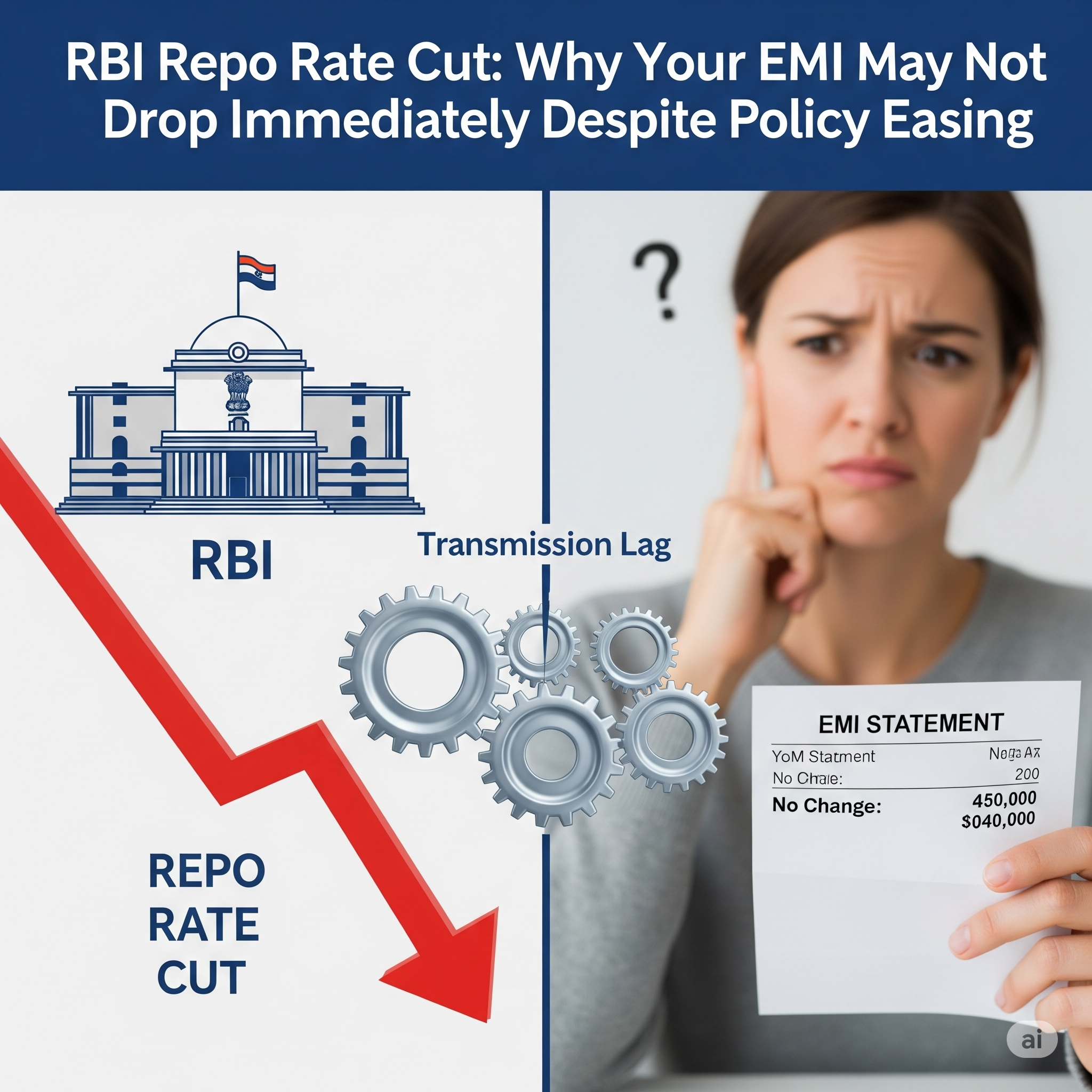
RBI Repo Rate Cut: Why Your EMI May Not Drop Immediately Despite Policy Easing
🏦 RBI Repo Rate Cut: EMI Relief May Be Delayed for Many Borrowers
The Reserve Bank of India’s recent repo rate cut of 50 basis points and a 100-bps reduction in the cash reserve ratio (CRR) has raised expectations among borrowers for lower EMIs. However, real-world relief may not arrive as swiftly or uniformly as anticipated.
Why so? Because the impact of a repo rate cut depends on several underlying factors—including loan type, benchmark linkage, and the lender’s internal transmission framework.
Let’s understand why not all borrowers may benefit immediately.
📌 Fixed or Floating Rate Loans: What’s the Difference?
Your loan’s nature—whether fixed-rate or floating-rate—determines how quickly, if at all, you’ll benefit from the RBI’s rate cut.
🔒 Fixed-Rate Loans: No Immediate Change
Loans like personal loans, credit card EMIs, and many car loans are often fixed-rate in nature. This means the interest rate decided at the time of disbursement remains unchanged throughout the loan tenure.
“Most personal and consumer loans are offered at fixed rates. Some categories, like car loans or loans against securities, may vary between fixed and floating,” said Adhil Shetty, CEO of BankBazaar.
Some public sector banks do offer floating-rate personal loans, but they’re the exception rather than the norm.
🌀 Floating-Rate Loans: Benchmark Matters RBI repo rate cut
Floating-rate loans, especially home loans, are more dynamic and directly affected by RBI policy changes—provided they’re linked to external benchmarks.
Since October 2019, all new floating-rate retail loans must be linked to external benchmarks like the RBI repo rate. However, older loans remain linked to internal benchmarks, such as the Marginal Cost of Funds Based Lending Rate (MCLR).
According to the RBI Annual Report 2024–25, over 35.9% of floating-rate loans still rely on MCLR—a major reason for the slow transmission of rate cuts.
🔄 MCLR vs EBLR: The Transmission Gap
📉 MCLR: Slower and Inconsistent
MCLR is an internal benchmark, influenced by:
- Banks’ cost of deposits and borrowings
- Operational overheads
- Risk premium for longer tenure
- Return expectations
- Negative carry on CRR holdings
“Even though the RBI has provided a formula for MCLR, banks modify it based on their internal costs and risk metrics,” explained Joydeep Sen, corporate trainer and author.
Moreover, MCLR-linked loans follow reset cycles—typically half-yearly or yearly—delaying the benefit transmission further.
🚀 EBLR/RLLR: Faster and Transparent
Loans linked to External Benchmark Lending Rates (EBLR), especially the Repo-Linked Lending Rate (RLLR), adjust much faster—usually on a quarterly basis. These loans respond more directly to RBI’s repo rate actions.
For EBLR-linked borrowers, the full benefit of the repo cut is typically passed on more promptly, making them more responsive to policy easing.
🏢 NBFC Loans: Greater Flexibility, Lower Certainty RBI repo rate cut
Borrowers with NBFC loans face an entirely different scenario. While NBFCs are regulated by RBI, they aren’t required to adopt the same benchmark-linked lending structure as banks.
“NBFCs rely on internal pricing models influenced by their cost of funds, operating costs, and asset-liability mismatches,” said Jagadeesh Mohan, Founder of EMI Saver.
These companies often fund long-term loans via short-term borrowings, creating mismatches that discourage immediate rate pass-through.
📊 Key Factors Affecting NBFC Transmission:
- Internal reset cycles (often longer or undefined)
- Dependence on market borrowings or bank loans
- Business strategy and borrower risk profile
- Credit rating, which impacts their cost of funds
“NBFCs with stronger credit profiles are better positioned to pass on repo rate cuts due to cheaper access to funds,” said Abhishek Kumar, Founder of SahajMoney.
✅ Summary Table: EMI Impact by Loan Type
| Loan Type | Benchmark Type | Transmission Speed | Repo Rate Cut Impact |
|---|---|---|---|
| Home Loans (post-Oct 2019) | Repo (EBLR) | Fast (Quarterly) | Immediate or within 3 months |
| Home Loans (pre-Oct 2019) | MCLR | Slow (6–12 months) | Delayed |
| Personal Loans (mostly fixed) | Fixed | None | No benefit |
| Car Loans (mixed) | Fixed or Floating | Variable | Depends on terms |
| NBFC Loans | Internal models | Uncertain | Case-by-case basis |
📌 What Borrowers Should Keep in Mind
- Check your loan document to understand whether your loan is fixed-rate or floating-rate, and which benchmark it’s tied to.
- For MCLR-linked loans, contact your bank to know the next reset date.
- Consider switching to EBLR if you are eligible, especially for home loans.
- NBFC borrowers should inquire about reset policies and possible refinancing options if repo-linked rates offer savings.
📘 Disclaimer
This blog is intended for general informational purposes only. It reflects current developments regarding RBI’s repo rate policies, loan benchmarking systems, and lending practices across banks and NBFCs. Readers should consult their bank, lending institution, or certified financial advisor before making loan restructuring or switching decisions.
Estabizz Fintech disclaims any liability for actions taken based on this content. For expert assistance on refinancing, credit restructuring, or benchmark transition, contact our professionals at www.estabizz.com.
Expert Opinions on the RBI Monetary Policy Meeting: Will Interest Rates Remain Unchanged?
RBI MPC Meeting Unveils Innovative UPI Feature for Enhanced Financial Collaboration