Disclosing Pre-Existing Diseases in Health Insurance: Why It’s Crucial for a Hassle-Free Claim
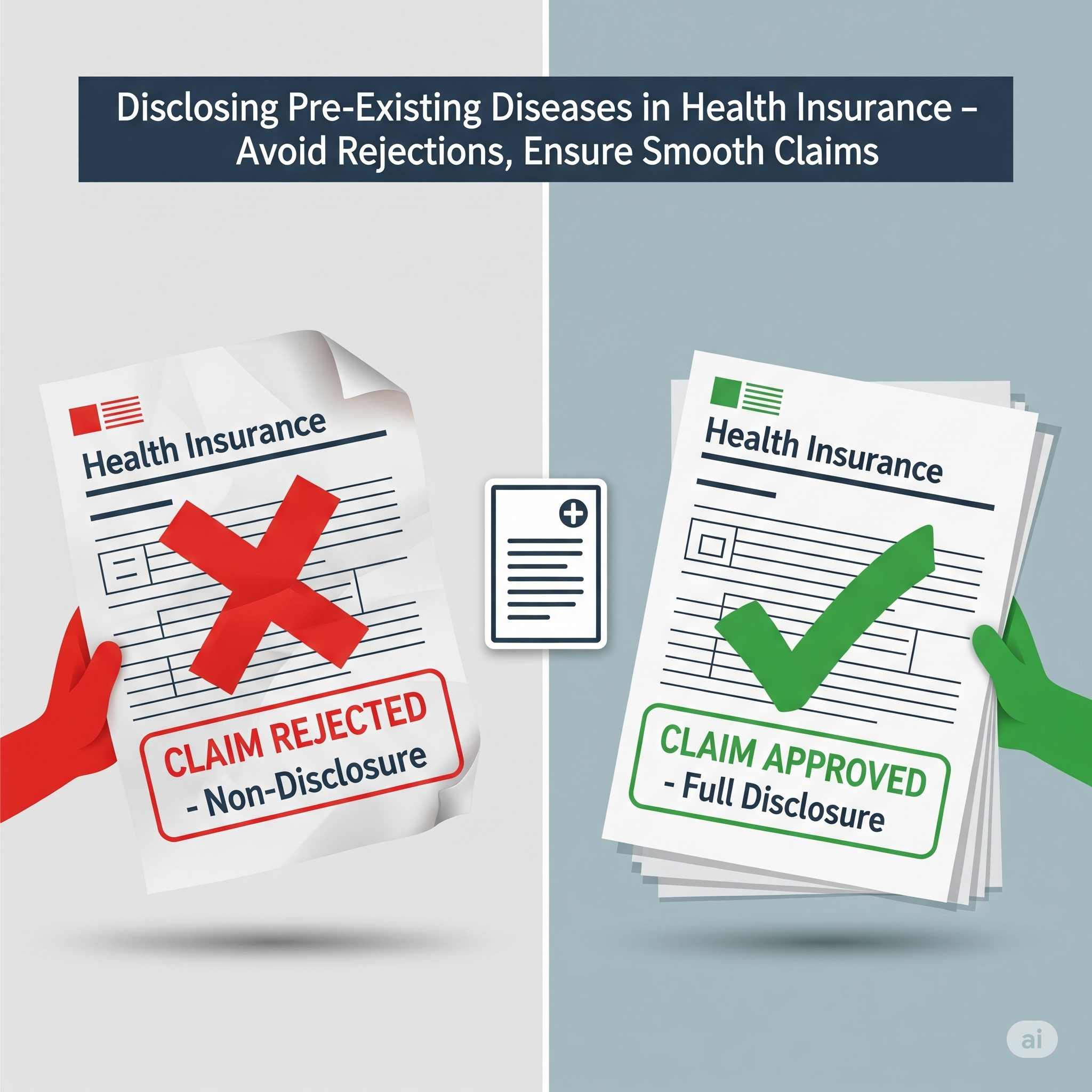
Disclosing Pre-Existing Diseases in Health Insurance – Avoid Rejections, Ensure Smooth Claims
Disclosing Pre-Existing Diseases in Health Insurance
When it comes to purchasing health insurance in India, disclosing pre-existing diseases is not just a formality—it is a vital responsibility. Many policyholders, often unknowingly, skip this crucial step and face painful consequences during medical emergencies when their claims are denied due to non-disclosure of medical history.
In this blog, we aim to explain what qualifies as a pre-existing disease, how far back you should go in disclosing your health records, and what legal protections policyholders enjoy under current IRDAI regulations.
What Is Considered a Pre-Existing Disease?
The term pre-existing disease (PED) refers to any condition, illness, or medical event for which the individual has been diagnosed, treated, or shown symptoms prior to the commencement of the health insurance policy.
This includes chronic and lifestyle ailments such as:
- Diabetes
- Hypertension (High Blood Pressure)
- Asthma
- Chronic Kidney Disease (CKD)
- Heart Conditions
- Epilepsy
- Cancer, Stroke, or major surgeries
In contrast, short-term illnesses like viral fever or minor injuries that have been fully resolved typically do not pose an issue for underwriters, unless they signal a larger underlying condition.
How Far Back Must You Disclose Your Medical History?
One common area of confusion is how many years of medical history need to be shared.
There is no rigid or officially stated time limit for such disclosures. Instead, what truly matters is the materiality of the health condition to the insurance underwriting process. If the condition is deemed relevant for assessing the risk or pricing the policy, it must be disclosed—regardless of when it was diagnosed.
“The insurer should not have any reason to believe that the proposer tried to hide relevant medical facts. Such acts may give rise to legitimate claim rejection,” explains Shilpa Arora, Co-founder and COO at Insurance Samadhan.
The Principle of Utmost Good Faith
Insurance contracts, especially health insurance, are governed by the principle of utmost good faith—a foundational legal doctrine in insurance law. This means both the insurer and the insured must be completely transparent in their dealings.
- Insured’s duty: Disclose all relevant medical conditions that could impact the insurer’s risk evaluation.
- Insurer’s duty: Clearly state all terms, conditions, inclusions, and exclusions upfront.
“Customers should let the insurer’s medical underwriting team assess the significance of any health condition, rather than making that judgment themselves,” advises Parthanil Ghosh, Executive Director, HDFC Ergo General Insurance.
Of course, trivial past ailments like a seasonal cold or short-term fever may not be crucial, but any chronic or recurring issues should never be omitted.
What Is the Moratorium Period?
To protect genuine policyholders, the Insurance Regulatory and Development Authority of India (IRDAI) mandates a moratorium period.
If your health insurance policy remains active continuously for five years, insurers cannot reject any claim on the grounds of non-disclosure—unless fraud is clearly established.
This ensures that even if you missed disclosing something unintentionally at the proposal stage, your rights remain protected after five years of uninterrupted coverage.
Waiting Period for Pre-Existing Conditions
As per IRDAI norms, any medical condition diagnosed or treated within 36 months before the policy commencement is considered a pre-existing disease.
Such conditions are typically covered only after a defined waiting period, which can be up to three years. However, the exact waiting period depends on the insurer’s terms.
“Some insurers allow a reduction in the waiting period to two years or even one month by attaching a special rider, usually for an additional premium of around 18–20%,” shares Siddharth Singhal, Head of Health Insurance, Policybazaar.
Moreover, insurers may choose to permanently exclude certain PEDs from coverage after reviewing your disclosures. This will be clearly mentioned in the policy document and must be acknowledged by the policyholder.
Common Misconceptions About PED Disclosure
A widespread misunderstanding is that disclosing pre-existing diseases leads to outright rejection or steep premiums.
This is not entirely true.
“Most insurers actually anticipate some level of medical history. They manage risks using tools like waiting periods, premium loadings, or specific condition exclusions,” clarifies Nisha Sanghavi, Director at Promore Fintech and a certified financial planner.
Honest disclosure gives you better protection and builds long-term trust with your insurer. More importantly, it avoids future hassles and heartbreak during a health emergency.
Practical Tips for Policyholders
| Step | Best Practice |
|---|---|
| 1. | Disclose all past and current major illnesses, including surgeries and lifestyle diseases. |
| 2. | Let the insurer decide the materiality of your health disclosures—do not self-filter. |
| 3. | Read the fine print in your policy document—especially on exclusions and waiting periods. |
| 4. | Consider using riders to reduce the waiting period or enhance coverage. |
| 5. | Keep a record of all disclosures made during the proposal stage. |
In Conclusion
Disclosing pre-existing diseases when buying health insurance is not just a regulatory requirement—it is a wise and responsible action. It protects you, ensures faster claims, and helps avoid unpleasant surprises when you need help the most.
In this matter, honesty is truly the best policy. As the old saying goes, “Satya hi raksha ka vichar hai”—truth is the foundation of protection.
So, whether you’re applying for your first policy or renewing an existing one, always take a few extra minutes to declare your health history completely. It’s a small step today that can safeguard your tomorrow.
📌 Estabizz Disclaimer:
This blog is intended for informational purposes only. For specific insurance advice and personalised health underwriting, kindly consult with a licensed insurance advisor or the insurer directly. Estabizz Fintech does not provide insurance sales or underwriting services.
IRDAI Takes Measures to Ensure Clarity and Simplify Insurance Policies through CIS
New Guidelines for Finfluencers: Registration and Qualifications Required from SEBI, IRDAI