Income Tax Phishing Scam Alert: How to Spot Fake Refund Emails & Stay Safe
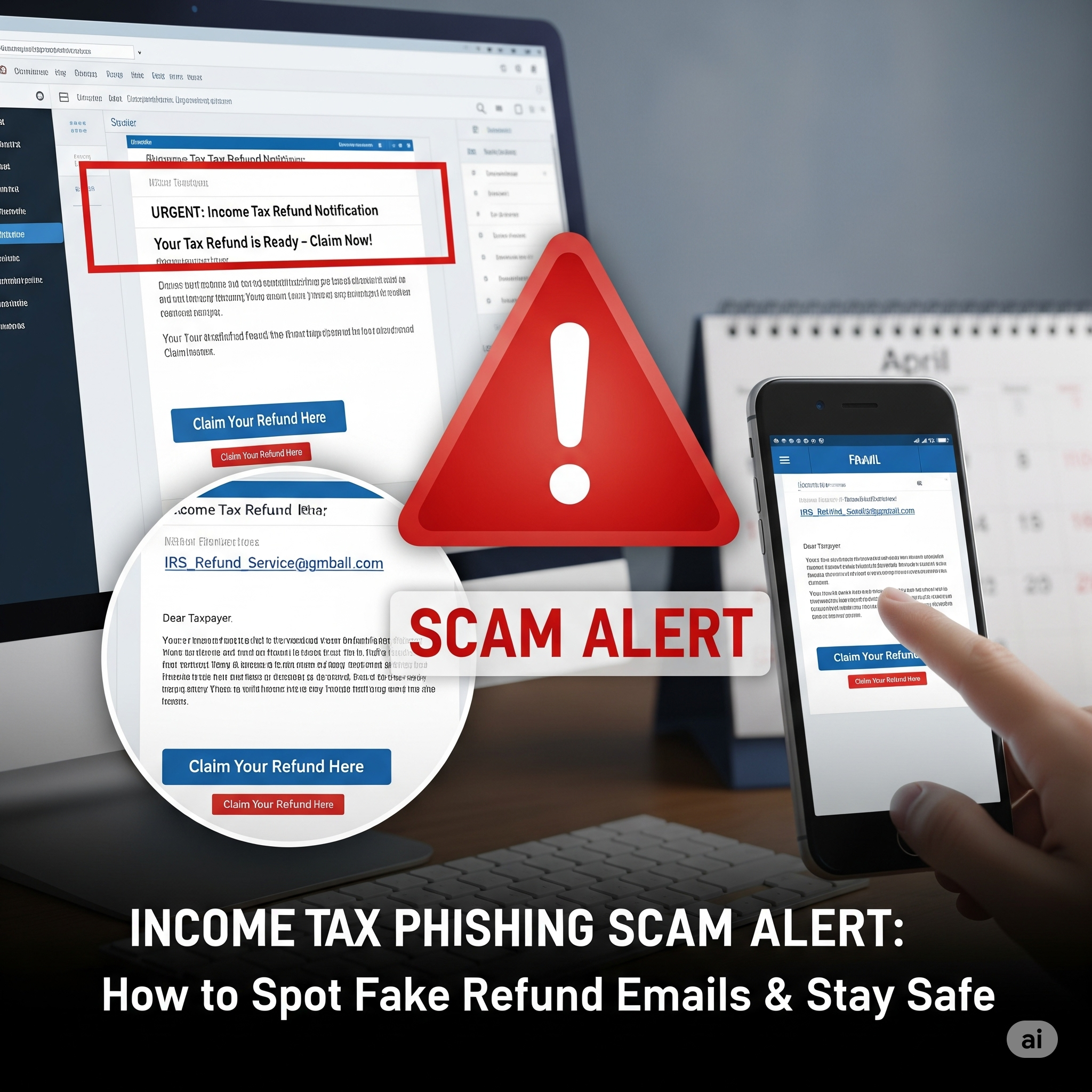
Income Tax Phishing Scam Alert: How to Spot Fake Refund Emails & Stay Safe
1. Executive Summary / Key Highlights
- Official Warning Issued: The Income Tax Department has flagged a phishing scam using the fake email ID
donotreply@incometaxindiafilling.gov.in. - Scam Modus Operandi: Victims receive emails claiming an error in tax calculation and offering a refund via malicious links.
- Primary Target: Taxpayers, MSMEs, startups, tax professionals, and regulated entities during ITR filing season.
- Risks Involved: Financial theft, identity fraud, legal exposure, operational downtime.
- How to Stay Safe: Verify sender domains (
@incometax.gov.in), never click on unverified links, report phishing attempts towebmanager@incometax.gov.in, and implement cybersecurity controls.
2. Understanding the Scam – Definition & Scope
What is a Phishing Scam?
Phishing is a cybercrime technique in which attackers impersonate legitimate organisations to trick individuals into revealing sensitive information such as passwords, OTPs, bank account numbers, or Aadhaar details.
In this case, scammers are impersonating the Income Tax Department during the peak Income Tax Return (ITR) filing season, when taxpayers are more likely to expect official communication.
3. Regulatory & Legal Context
The phishing scam not only breaches cybersecurity laws but can also lead to criminal liability for perpetrators:
- Information Technology Act, 2000
- Section 43: Penalty for unauthorised access to computer systems.
- Section 66D: Punishment for cheating by personation using computer resources (up to 3 years imprisonment + fine).
- Indian Penal Code (IPC)
- Section 420: Cheating and dishonestly inducing delivery of property.
- Section 468: Forgery for the purpose of cheating.
- CERT-In Advisory
- India’s nodal cyber agency frequently issues alerts regarding phishing campaigns targeting government portals.
- RBI Cybersecurity Framework (for regulated entities)
- Requires banks and NBFCs to have incident response mechanisms for phishing attacks.
4. Who Is at Risk – Applicability
| Category | Risk Level | Why They’re Targeted |
|---|---|---|
| Individual Taxpayers | High | Expecting refunds, less tech-savvy |
| MSMEs & Startups | High | Multiple GST/IT filings, lower IT security budgets |
| Tax Professionals | Very High | Access to sensitive client databases |
| Large Corporates | Medium | Stronger IT controls but still susceptible |
| Trusts, Societies, NGOs | Medium | May not have dedicated IT teams |
| Regulated Entities (NBFCs, Insurance Brokers) | High | Handle high-value transactions |
5. How the Scam Works – Step-by-Step Modus Operandi
| Step | Scammer’s Action | Victim’s Reaction | Outcome |
|---|---|---|---|
| 1 | Create fake domain incometaxindiafilling.gov.in |
Victim assumes it’s official | Trust established |
| 2 | Send mass phishing emails during tax season | Victim believes it’s refund communication | Urgency created |
| 3 | Insert malicious link/button in email | Victim clicks without verification | Redirect to fake portal |
| 4 | Fake portal mimics official I-T login | Victim enters PAN, DOB, bank details | Data stolen |
| 5 | Attackers use credentials for fraud | Funds withdrawn, identity stolen | Financial loss |
6. Technical Indicators to Identify the Scam
- Domain Name Typos: Official site is
incometax.gov.in— scammers useincometaxindiafilling.gov.in. - Grammatical Errors: Emails may have minor language mistakes.
- Generic Greetings: “Dear Taxpayer” instead of your actual name.
- Suspicious Links: Hovering over links shows mismatched URLs.
- Urgent Refund Claims: Pressure to act immediately.
7. Real-World Consequences
Case Study – MSME Loss
A garment exporter clicked on a refund email, entered bank credentials, and lost ₹8.5 lakh within 24 hours.
Case Study – Chartered Accountant Firm Breach
A phishing email to a CA firm led to compromise of 120 client accounts and subsequent tax refund fraud.
8. Prevention – Compliance Checklist for MSMEs & Startups
| Action Item | Frequency | Responsible Department |
|---|---|---|
Verify all official emails from @incometax.gov.in |
Ongoing | Finance/Compliance |
| Conduct phishing awareness training | Quarterly | HR/IT |
| Enable 2FA on bank accounts & tax portals | Immediate | IT/Finance |
| Use email filtering & anti-phishing tools | Continuous | IT |
| Maintain incident response SOP | Annual review | Compliance |
9. Cyber Incident Reporting Process Income Tax Phishing Scam
If you receive a suspected phishing email:
- Do Not Click Any Links.
- Forward Email to
webmanager@incometax.gov.in. - Report to CERT-In at
incident@cert-in.org.in. - If financial data is compromised, inform your bank immediately.
- Lodge a cybercrime complaint at https://cybercrime.gov.in.
10. Government & CERT-In Advisories Income Tax Phishing Scam
- Income Tax Dept. Alert (Aug 2025): Official X handle warns against fake refund emails.
- CERT-In Advisory 2025-IT-06: Phishing campaigns targeting Indian government portals during peak filing seasons.
- RBI Financial Cybersecurity Guidelines: Recommends phishing simulations for BFSI staff.
11. Best Practices for Organisational Security Income Tax Phishing Scam
- Maintain separate devices for financial transactions.
- Regularly update antivirus and firewall settings.
- Limit admin access to financial systems.
- Use email authentication protocols (SPF, DKIM, DMARC) to prevent domain spoofing.
- Periodically simulate phishing attacks internally.
12. Past Phishing Incidents – Learning Points Income Tax Phishing Scam
- 2019 Income Tax Refund Scam: Similar modus operandi using fake refund SMS.
- 2021 GST Portal Phishing: Fraudulent login page used to capture GST credentials.
Learning: Seasonal compliance deadlines are high-risk periods for phishing.
13. Conclusion & Call-to-Action Income Tax Phishing Scam
The Income Tax phishing scam is a timely reminder that cybersecurity is a compliance responsibility.
For MSMEs, startups, and regulated entities, investing in preventive security is far cheaper than managing post-breach damage.
Estabizz Fintech offers:
- Compliance-driven cybersecurity audits
- Employee phishing awareness training
- Tax-season cyber risk assessment
📞 Contact us to secure your compliance operations before scammers strike.
14. Branded Disclaimer – Estabizz Fintech Income Tax Phishing Scam
This blog is for informational purposes only and does not constitute tax, legal, or cybersecurity advice. Content is based on official advisories and public information as of the date of publication. Laws, rules, and threats may change over time. Readers should seek professional consultation before acting on any information. Estabizz Fintech assumes no liability for loss or damage arising from reliance on this content.
FAQs – Income Tax Phishing Scam
General Understanding
- What is the Income Tax phishing scam?
It’s a fraudulent email or message campaign where scammers impersonate the Income Tax Department to trick taxpayers into revealing sensitive data such as PAN, Aadhaar, bank details, or passwords, usually by offering a fake tax refund. - Why are phishing scams common during ITR filing season?
Because taxpayers expect official communications during this period, making them more likely to trust emails about refunds, verification, or filing errors. - What fake email ID is currently being used in the scam?
donotreply@incometaxindiafilling.gov.in— note the misspelling (“filling” instead of “filing”) and the fake domain. - Does the Income Tax Department send refund notifications via email?
It may send intimation emails, but refunds are credited directly to your bank account linked to your PAN and communicated via the official portal, not through links asking for credentials. - What is the official domain for Income Tax Department emails?
All official emails come from addresses ending in@incometax.gov.in.
Risks & Impact
- What happens if I click a phishing link?
The link may lead to a fake portal that captures your login credentials, bank details, or installs malware on your device. - Can phishing scams lead to direct bank account theft?
Yes. If you enter sensitive details, fraudsters can initiate unauthorised transactions. - Is identity theft possible from phishing scams?
Absolutely. Stolen PAN, Aadhaar, and KYC data can be used to open loans or commit fraud in your name. - Can my business data be compromised?
Yes. For MSMEs, compromised email accounts can expose GST, TDS, and payroll records. - Are phishing scams only email-based?
No. They can also occur via SMS, WhatsApp, fake websites, and even phone calls.
Identification
- How can I spot a phishing email?
Look for suspicious sender domains, grammar errors, urgent refund claims, and mismatched URLs. - Why is domain verification important?
Because cybercriminals often use lookalike domains that closely mimic official ones. - What is the difference between
@incometax.gov.inand@incometaxindiafilling.gov.in?
The former is official; the latter is fake and not associated with the Income Tax Department. - Can hovering over a link reveal it’s a scam?
Yes. Hover to see the real URL without clicking — if it doesn’t point toincometax.gov.in, it’s likely fraudulent. - Are official I-T emails personalised?
Yes, genuine emails often include your name or PAN, unlike generic “Dear Taxpayer” messages.
Regulatory & Legal
- Is phishing a crime in India?
Yes, it is punishable under Section 66D of the IT Act, 2000 and Section 420 of the IPC. - What is the penalty for phishing in India?
Up to 3 years imprisonment and/or fine under the IT Act, along with additional IPC penalties. - Does RBI have guidelines on phishing?
Yes, RBI requires banks to implement anti-phishing measures and educate customers. - What role does CERT-In play?
It is India’s nodal cyber agency that issues phishing alerts and handles incident coordination. - Can I claim compensation if I’m a phishing victim?
Possible in some cases through cybercrime complaints or consumer courts, depending on proof.
Preventive Measures
- How can I protect myself from phishing scams?
Verify sender addresses, avoid clicking unknown links, use antivirus, and enable two-factor authentication. - What should I do before clicking on a tax-related email link?
Cross-check your tax status on the official portal. - Can antivirus software block phishing sites?
Many updated antivirus solutions include anti-phishing protection. - Should businesses conduct phishing simulations?
Yes, especially those handling sensitive tax or financial data. - Is employee training important for phishing prevention?
Yes. Human error is the biggest vulnerability in phishing incidents.
Reporting & Response
- How do I report a phishing email to the Income Tax Department?
Forward it towebmanager@incometax.gov.in. - Where can I report cyber fraud in India?
Visit https://cybercrime.gov.in and file a complaint. - Should I inform my bank after clicking a phishing link?
Yes, immediately block your account or cards to prevent unauthorised transactions. - Can the police help in phishing cases?
Yes, cybercrime police units handle phishing-related complaints. - Do I need to lodge an FIR for phishing?
It is advisable if there has been a financial or data loss.
Special Scenarios
- Are senior citizens more at risk of phishing scams?
Yes, due to less familiarity with digital processes. - Can phishing emails be sent to multiple people in an organisation?
Yes, attackers often target entire mailing lists. - Are phishing attacks seasonal?
They peak during tax filing seasons, banking deadlines, and festive periods. - Do scammers ever use phone calls with phishing emails?
Yes, this is called “vishing” and often follows up a phishing email. - Can phishing scams be international?
Yes, attackers may operate from outside India.
Technical Aspects
- What is email spoofing in phishing?
It’s when a fake email is made to look like it’s from a trusted source. - What are SPF, DKIM, and DMARC in email security?
These are authentication methods to prevent email spoofing. - How do scammers register lookalike domains?
They buy similar domain names with slight spelling changes. - Can phishing links install malware?
Yes, clicking can trigger malware downloads. - Can phishing scams bypass spam filters?
Sometimes, especially if attackers use sophisticated evasion tactics.
Aftermath & Recovery
- What should I do if I shared my PAN in a phishing form?
Monitor your financial transactions and file a cyber complaint. - If I entered bank details on a fake site, what next?
Immediately inform your bank, block accounts/cards, and change passwords. - Can I recover stolen money from phishing?
Quick reporting increases chances but recovery is not guaranteed. - Should I change my tax portal password after a phishing attempt?
Yes, even if you did not click any link. - Do phishing victims need credit monitoring?
Yes, to detect misuse of personal information.
Education & Awareness
- Where can I learn more about phishing scams?
Follow advisories from the Income Tax Department, CERT-In, and RBI. - Does the I-T Department conduct public awareness campaigns?
Yes, via social media and press releases. - Can schools and colleges teach phishing awareness?
Yes, under cybersecurity education programs. - Is phishing training mandatory for financial institutions?
RBI guidelines recommend it for BFSI sector employees. - What is the most important rule to avoid phishing scams?
Never click on unsolicited links or share confidential details without verification. - How can MSMEs build a phishing response plan?
By integrating cyber incident SOPs into compliance frameworks.
Income Tax Deduction from Salaries in Financial Year 2024-25 Under Section 192 – A Complete Guide
Analyzing Income Tax Trends through Diverse Lenses: Social Media Insights and High-profile Taxpayers