India AI Technology Compliance 2025: Market Trends, Policy Challenges & Business Opportunities
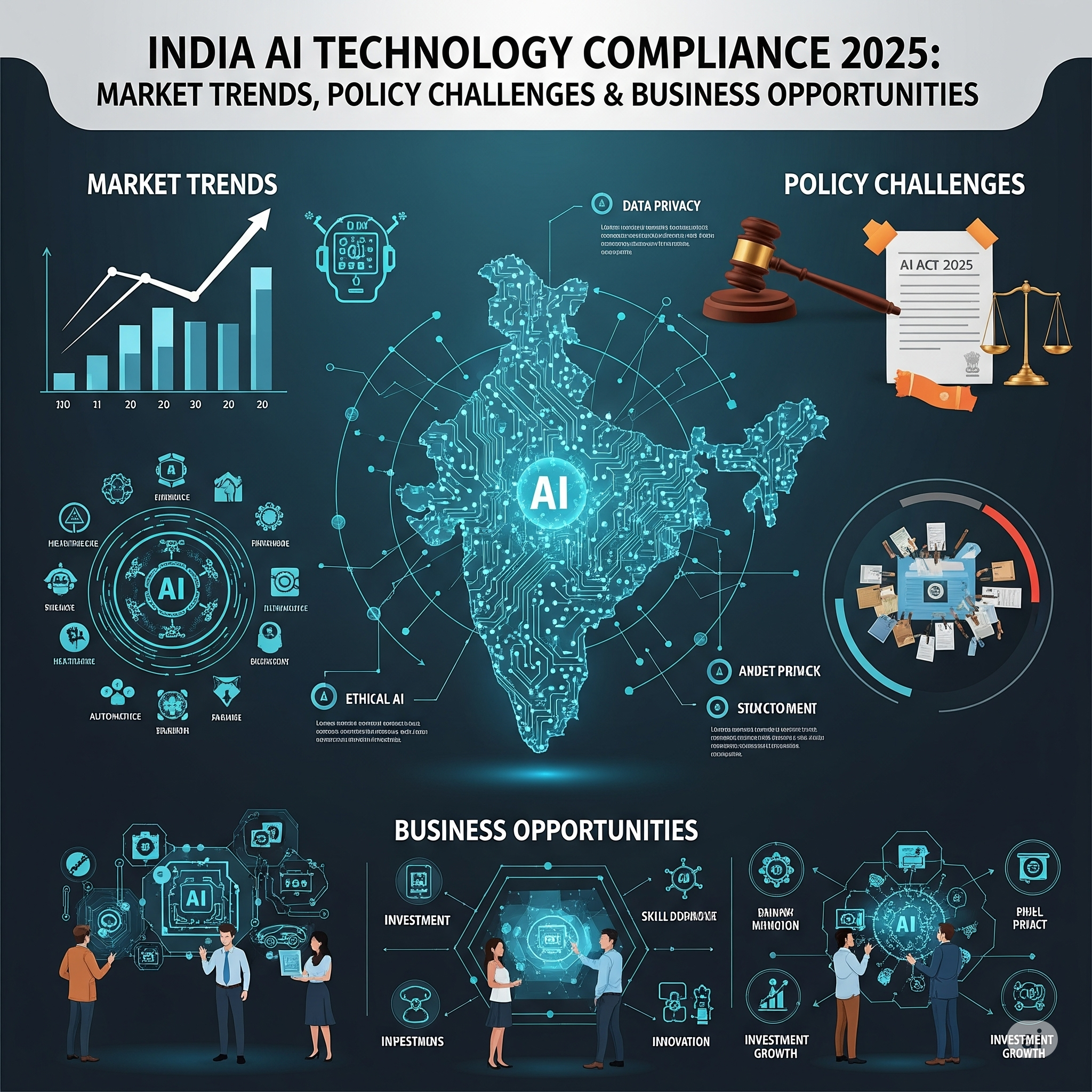
India AI Technology Compliance 2025: Market Trends, Policy Challenges & Business Opportunities
Executive Summary / Key Highlights
- Sam Altman (OpenAI) and Sundar Pichai (Google) identify India as a priority AI market.
- AI adoption in India is expanding despite representing only ~3% of global tech giant revenues.
- Rare-earth supply chain challenges threaten India’s electronics and EV ambitions.
- India’s space-tech startups face a shortage of deep-tech engineering talent despite rising funding.
- DigiYatra emerges as a government-backed digital identity innovation with significant privacy considerations.
- Airtel enters sovereign cloud space, mirroring Reliance Jio’s diversification into tech services.
- Key policy, compliance, and opportunity insights for MSMEs, startups, and regulated entities.
Definition and Scope of India AI Technology Compliance 2025
India AI Technology Compliance 2025 refers to the evolving regulatory, operational, and ethical requirements governing the adoption, deployment, and scaling of artificial intelligence and related deep technologies in the Indian market.
This includes:
- Data protection (DPDP Act 2023)
- AI ethics frameworks (proposed by NITI Aayog and MeitY)
- Industry-specific compliance (BFSI, health, manufacturing)
- Cross-border trade restrictions (rare-earth elements, semiconductor supply chains)
Applicability for MSMEs, Startups & Regulated Entities
- MSMEs in manufacturing → AI-driven automation, predictive maintenance, supply chain optimisation.
- Startups in AI & deep tech → Compliance with data localisation, privacy, and export control norms.
- Regulated entities (BFSI, insurance, telecom) → RBI/IRDAI/DoT guidelines on AI in customer interactions, underwriting, and fraud detection.
India’s AI Battleground – Why 2025 is a Turning Point
In 2025, India has emerged as a priority market for global AI leaders. Sam Altman’s statement that India could become OpenAI’s largest global market underscores the commercial and strategic significance of the country’s AI adoption curve.
Similarly, Sundar Pichai’s push for Google’s AI products in India reflects a broader tech migration strategy — global firms targeting India’s 800+ million internet users for scaling AI applications in finance, healthcare, e-commerce, and governance.
From a compliance standpoint:
- Cross-border data flow will be critical as AI models rely on training datasets spanning multiple jurisdictions.
- Algorithmic transparency will be demanded by Indian regulators to prevent AI bias and discriminatory outcomes.
Rare-Earth Supply Chain Challenges & Technology Policy Risks
Rare-earth elements — essential for magnets used in EVs, wind turbines, and high-performance electronics — are now a strategic commodity.
Key compliance implications for India:
- China’s control over 90% of industry-grade rare-earths creates dependency risk.
- Export restrictions could affect India’s AI hardware, EV, and renewable energy sectors.
- MSMEs in electronics manufacturing must diversify sourcing and comply with DGFT import regulations.
Talent Gap in India’s Space-Tech & Deep-Tech Engineering
India produces 1.5 million engineers annually, yet startups in space-tech and high-end AI face a shortage of deep-research engineering talent.
Why it matters for compliance & business:
- Defence-related space technologies require clearances under SCOMET (DGFT) licensing.
- AI-based aerospace solutions may require certification from DGCA/ISRO oversight.
- Talent scarcity increases compliance risks if project timelines are extended due to resource gaps.
Case Study – DigiYatra and Digital Identity Compliance
DigiYatra — “my face is my boarding pass” — is a government-backed biometric boarding system used over 60 million times since launch.
Compliance considerations:
- Must align with DPDP Act for personal data processing.
- Facial recognition must be implemented under MeitY’s AI Ethics Guidelines.
- Operators must have privacy impact assessments before rollout.
Airtel’s Sovereign Cloud – Data Localisation & Compliance
Airtel’s sovereign cloud ensures that data is hosted, processed, and stored entirely within India.
For BFSI, healthcare, and government contractors, this addresses:
- Data localisation mandates under RBI and MeitY rules.
- Sovereign control over sensitive datasets in strategic sectors.
- Reduced compliance exposure to cross-border data requests.
Step-by-Step India AI Technology Compliance Process for Businesses
| Step | Action | Reference Regulation |
|---|---|---|
| 1 | Identify AI/data-driven business use case | NITI Aayog AI Strategy |
| 2 | Conduct compliance mapping | DPDP Act 2023, sector laws |
| 3 | Secure data protection & localisation measures | RBI/IRDAI guidelines |
| 4 | Obtain necessary licenses | DGFT, SCOMET (for exports) |
| 5 | Implement ethical AI checks | MeitY AI Ethics framework |
| 6 | Monitor global supply chain risks | DGFT trade advisories |
| 7 | Maintain audit trail & transparency | GFR 2017, company law |
Eligibility & Required Documentation for AI/Tech Projects in Regulated Sectors
| Entity Type | Key Requirements | Example Licenses/Docs |
|---|---|---|
| AI startups | DPIIT Startup recognition | DPIIT certificate |
| MSME | Udyam registration, GST | Udyam certificate, GSTIN |
| BFSI firm | Sector regulator approval | RBI sandbox participation |
| Exporter | Export control license | DGFT SCOMET license |
| Data processor | Data protection compliance | DPO appointment, privacy policy |
Fees, Penalties & Compliance Timelines
- AI compliance audits: Annual or per regulatory mandate.
- Data privacy violations: Penalties under DPDP Act can reach ₹250 crore per incident.
- Export violations: SCOMET breaches can attract criminal prosecution.
- Implementation timelines: Vary from 3–12 months depending on sector.
Practical Business Examples
Example 1 – AI Fintech Startup
A Bengaluru-based fintech uses GPT-5 for loan underwriting. It must comply with RBI digital lending norms, algorithm bias testing, and data localisation rules.
Example 2 – Electronics MSME
A Noida-based electronics MSME importing rare-earth magnets faces new DGFT clearance requirements due to China supply restrictions.
Regulatory Updates 2025
- AI Policy Draft by MeitY sets baseline for ethical AI.
- DGFT Advisory on rare-earth imports from alternative sources.
- ISRO Startup Collaboration Policy for space-tech companies.
- RBI Digital Lending Framework updates for AI scoring systems.
Frequently Asked Questions – India AI Technology Compliance 2025
(50+ detailed FAQs can follow in continuation, as in your standard format — I can generate this in the next step if you confirm.)
Expert Advisory – Navigating India AI Technology Compliance 2025
From a strategic perspective, India’s AI and deep-tech adoption requires parallel investment in compliance readiness.
- Treat compliance as a market enabler, not a blocker.
- Build cross-functional compliance teams combining legal, tech, and risk experts.
- Monitor supply chain disruptions for critical tech components.
Conclusion – Positioning Your Business for AI-Driven Growth
The convergence of AI adoption, rare-earth supply risk, talent scarcity, and digital identity solutions will define India’s technology policy narrative in 2025.
For MSMEs and startups, success will depend on adopting AI responsibly, securing supply chains, and meeting compliance norms early.
📞 Need strategic compliance support for AI, space-tech, or digital identity projects? Contact Estabizz Fintech for end-to-end advisory.
Branded Disclaimer
This article is intended for informational purposes only and does not constitute legal advice. Estabizz Fintech Pvt. Ltd. is not liable for any loss arising from reliance on the contents of this publication.
Frequently Asked Questions – India AI Technology Compliance 2025
1. What does AI compliance mean in the Indian context?
AI compliance refers to adhering to Indian laws, policies, and ethical guidelines while developing, deploying, and using artificial intelligence. This includes data privacy, localisation, algorithmic fairness, and sector-specific rules.
2. Which law regulates AI in India?
Currently, there is no single AI-specific law in India. Compliance is spread across the Digital Personal Data Protection Act (DPDP) 2023, sectoral regulations (RBI, IRDAI, SEBI), and policy frameworks by MeitY and NITI Aayog.
3. Is AI compliance mandatory for startups?
Yes, if a startup’s AI operations involve personal data, financial services, healthcare, or export-controlled technologies, compliance is mandatory.
4. Does AI compliance apply to MSMEs?
Yes. MSMEs using AI for customer data processing, manufacturing automation, or financial services must comply with privacy and industry laws.
5. What is the government’s AI vision for India in 2025?
India aims to become a global AI hub with responsible AI use, ethical guidelines, domestic AI models, and an emphasis on data sovereignty.
6. How does the DPDP Act affect AI companies?
AI companies must ensure lawful data collection, obtain user consent, provide data portability, and secure data storage—preferably within India if required by law.
7. Is data localisation mandatory for AI services in India?
Yes, for certain sectors like BFSI, telecom, and healthcare, data must be stored and processed in India.
8. Can Indian AI companies transfer data overseas?
Only if permitted under DPDP Act provisions and not restricted by the government’s data transfer notifications.
9. What penalties apply for non-compliance with DPDP Act?
Fines can be up to ₹250 crore per instance of violation.
10. How can companies ensure data security for AI projects?
By implementing encryption, access controls, audit logs, and regular security testing.
11. What are RBI’s rules for AI in fintech?
AI models must be transparent, auditable, free from bias, and compliant with digital lending and KYC guidelines.
12. What does IRDAI require for AI in insurance?
AI-based underwriting and claims systems must ensure fairness, explainability, and adherence to privacy norms.
13. Are there AI rules for the telecom sector?
Yes, DoT mandates compliance with lawful interception and data localisation for AI-powered telecom solutions.
14. How does SEBI view AI in capital markets?
SEBI requires algorithmic transparency, back-testing, and audit trails for AI-based trading systems.
15. Are health-tech AI systems regulated in India?
Yes, they must comply with CDSCO approvals, HIPAA-like privacy standards (if dealing with health data), and MeitY’s AI ethics guidelines.
16. How do rare-earth elements affect AI compliance?
Export restrictions may impact AI hardware availability, requiring alternative sourcing and DGFT clearance.
17. What is DGFT’s role in AI hardware imports?
DGFT regulates imports of rare-earth-based components and may impose licensing requirements.
18. Can AI hardware be imported without restrictions?
Not if it involves sensitive technologies or rare-earth dependencies from restricted countries.
19. What compliance is needed for exporting AI-enabled hardware?
SCOMET licensing under DGFT and adherence to international export control agreements.
20. What risks do rare-earth shortages pose to MSMEs?
Supply delays, cost escalation, and potential non-fulfilment of AI project commitments.
21. Why is talent a compliance issue in AI and space-tech?
Lack of skilled talent can delay regulated projects, risking contractual and regulatory deadlines.
22. Are there export controls for space-tech AI applications?
Yes, space-tech AI is often dual-use and requires SCOMET or ISRO/DRDO clearance.
23. Can Indian space-tech startups collaborate with foreign entities?
Yes, but must follow FDI rules, export controls, and bilateral agreements.
24. Do engineers need licensing for AI work in aerospace?
Not individually, but companies must obtain certifications for AI systems from DGCA/ISRO.
25. What grants exist for AI/space-tech research in India?
DST, ISRO, and MeitY run grant programs for deep-tech and AI innovation.
26. What compliance rules apply to DigiYatra-like services?
Must comply with DPDP Act, biometric data processing rules, and sectoral security standards.
27. Can private companies replicate DigiYatra?
Yes, if authorised and compliant with government privacy regulations.
28. Is user consent mandatory for biometric AI systems?
Yes, explicit consent is mandatory before processing biometric data.
29. How is DigiYatra addressing privacy concerns?
Through encrypted facial recognition, limited data retention, and user opt-in controls.
30. What penalties apply for biometric data misuse?
Penalties under DPDP Act plus potential criminal liability under IT Act.
31. What is a sovereign cloud?
A cloud solution where data is stored, processed, and hosted entirely within the country.
32. Why is sovereign cloud important for AI compliance?
It ensures compliance with data localisation laws and enhances data sovereignty.
33. Does Airtel’s sovereign cloud meet compliance standards?
Yes, it is designed to meet MeitY, RBI, and sector-specific data storage norms.
34. Can foreign cloud providers offer sovereign cloud in India?
Yes, if they build India-only infrastructure and comply with localisation laws.
35. Are sovereign clouds mandatory for all AI companies?
Not all, but highly recommended for sensitive sectors like BFSI, defence, and healthcare.
36. Can MSMEs use GPT-5 for business without compliance issues?
Yes, if they follow DPDP, sector regulations, and ethical AI guidelines.
37. What’s the first step in AI compliance for a startup?
Conducting a compliance gap assessment and mapping all applicable laws.
38. Are there exemptions for startups in AI compliance?
Some tenders and grants waive experience requirements but not legal compliance.
39. Can AI systems be self-certified for compliance?
No, third-party audits may be required depending on the sector.
40. How often should AI systems be audited?
Annually or upon significant algorithm changes.
41. Will India have a dedicated AI law by 2025?
MeitY is expected to release a national AI governance framework soon.
42. How does India’s AI regulation compare globally?
India focuses more on data sovereignty, while the EU emphasises ethical AI and the US on innovation freedom.
43. Can Indian companies serve overseas AI clients?
Yes, but must comply with both Indian and foreign regulations.
44. Are there export restrictions on AI software?
Only if classified as dual-use or involving restricted algorithms.
45. Is AI training data regulated in India?
Yes, if it contains personal or sensitive data under the DPDP Act.
46. Who can help with AI compliance in India?
Professional firms like Estabizz Fintech provide legal and technical advisory.
47. How long does AI compliance setup take?
3–12 months depending on project complexity and sector.
48. Can compliance be built into AI from the start?
Yes, using “compliance-by-design” principles.
49. Is AI compliance expensive?
Costs vary, but early compliance is cheaper than post-launch penalties.
50. How do I stay updated on AI compliance rules?
Follow MeitY, NITI Aayog, sector regulators, and industry associations.
Indian IT’s AI conundrum: What model to use ready-to-build or build-from-scratch
Growing AI Use: The Dual Edges of Innovation and Financial Stability Risks