India Go Global or Local Play? Navigating Trade, Innovation, and Domestic Competitiveness in 2025
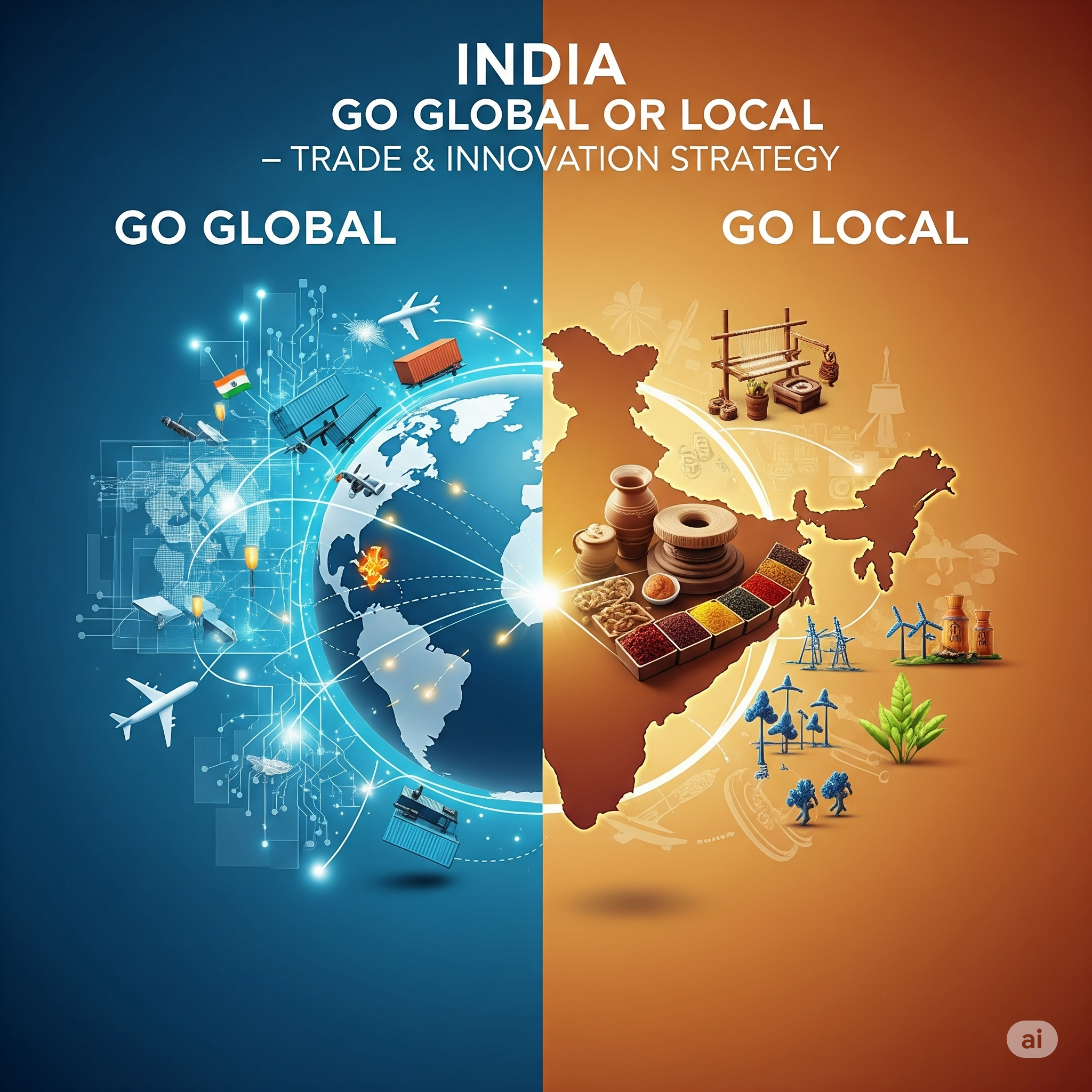
India Go Global or Local – Trade & Innovation Strategy
Executive Summary / Key Highlights India Go Global or Local
- Global trade disruption and US protectionist moves reignite India’s 1991-style reform debate.
- India need not choose between global integration and domestic focus — the winning strategy is both.
- Policy must enable wider trade bloc integration, cheaper imports, and domestic competitive intensity.
- Private investment revival hinges on demand-side support and removal of legacy restrictions.
- Agricultural reform is critical — market orientation over subsidy dependence.
- Factor market reforms must address labour’s AI challenge while keeping capital flows healthy.
- Export growth depends not only on cost advantage but also on innovation leadership.
Why the Debate Has Returned
In 2025, geopolitical shifts have intensified — the US is taking a more protectionist stance, redrawing trade alliances, and prompting countries to re-evaluate their strategies.
For India, this situation mirrors the post-1991 reform moment:
- In 1991, India faced a balance-of-payments crisis and embraced liberalisation.
- In 2025, India faces a choice crisis — whether to double down on self-reliance and domestic consumption or accelerate export-oriented global integration.
But unlike 1991, India is now:
- The fifth-largest economy globally.
- A key player in global supply chains in IT, pharma, textiles, and services.
- Facing AI-led industrial disruption in labour markets.
Why India Can Do Both
The question is often framed as either “Go global” or “Play local.” But a strong economy can — and must —:
- Use global demand to fuel growth in high-value sectors.
- Use local reforms to strengthen domestic resilience and competitiveness.
Key Argument: Export thrust without domestic competitiveness collapses under global pressure.
Domestic strength without global integration leads to stagnation.
The Case for “Going Global”
Policy & Trade Bloc Integration for India Go Global or Local Strategy
- India is not a member of RCEP or CPTPP, missing preferential access to major markets.
- Without FTAs, exporters face tariff disadvantages against competitors from bloc members.
- Integration into trade blocs = larger addressable market and supply chain resilience.
Policy Move: Prioritise high-impact FTAs with EU, UK, GCC, and Indo-Pacific alliances.
Cheaper Imports & Competitiveness in India Go Global or Local Debate
- High input tariffs raise manufacturing costs.
- Example: Indian electronics manufacturers import semiconductors at higher costs vs. Vietnam (FTA with major suppliers).
- Removing/reducing tariffs on strategic inputs lowers cost base and improves export pricing.
Policy Move: Rationalise import tariffs on intermediate goods & advanced tech.
Demand for Innovation, Not Just Cost Efficiency
- Competing solely on cost keeps India in low-value segments.
- High-value exports (pharma innovation, AI solutions, green tech) bring higher margins.
- Innovation also creates sticky global demand.
Policy Move: Redirect PLI incentives to innovation-linked milestones.
4. The Case for “Playing Local”
Boosting Competitive Intensity at Home
- Domestic monopolies and restrictive rules hurt efficiency.
- Healthy competition = lower prices, better products, and readiness for global competition.
Policy Move: Dismantle regulatory capture, open more sectors to private competition.
Role of Private Investment (“Animal Spirits”)
- Investors are waiting for broad-based demand growth before committing capital.
- Demand-side stimulus (e.g., targeted income support) can trigger investment cycles.
Policy Move: Time-bound direct benefit transfers to boost consumption.
Agricultural Market Orientation
- Agriculture still operates under price controls, mandi restrictions, and export bans.
- Market-oriented reforms = higher farmer incomes + competitive agribusiness exports.
Policy Move: Expand e-NAM, liberalise agri-exports, enable contract farming security.
Removing Legacy Restrictions on Enterprise
- Many colonial-era and socialist-era rules persist, adding compliance friction.
- Cutting these boosts MSME ease of doing business and encourages formalisation.
Policy Move: Sunset clauses for outdated laws; regulatory guillotine model.
Factor Market Reforms – The Balancing Act
Capital
- India’s capital market depth has improved; external debt is manageable.
- Continued macro stability is key to attracting long-term FDI.
Policy Move: Predictable tax regime for foreign investors.
Labour & AI Disruption
- AI is automating service and manufacturing jobs.
- Risk: Labour-intensive sectors (BPO, garment manufacturing) losing competitiveness.
Policy Move: Upskilling workforce in AI-adjacent skills; incentivise industries blending AI with human labour.
Currency Policy
- A rupee that reflects trade fundamentals (not just capital flows) can improve export pricing.
- But currency depreciation is not a substitute for innovation.
Policy Move: Maintain exchange rate flexibility but prioritise export value-add.
From Cost Advantage to Innovation Leadership
Why Innovation Matters More Now
- Countries like Vietnam & Bangladesh are catching up on cost efficiency.
- Only innovation creates products “the world can’t get enough of.”
Key Sectors for Innovation-Led Exports
- Renewable energy tech.
- AI & machine learning applications.
- Advanced pharma & biotech.
- Space tech and defence manufacturing.
Policy Move: R&D tax credits, IP protection reforms, university-industry research linkages.
Trend Reversals Needed for Success
- From protectionism → open integration in strategic sectors.
- From state-heavy resource allocation → private sector-led efficiency.
- From consumption-based growth → innovation-driven exports.
- From subsidy culture → competitive capacity-building.
Implementation Roadmap (5 Years)
| Year | Global Moves | Domestic Moves |
|---|---|---|
| 2025–26 | Conclude EU & UK FTAs | Remove outdated enterprise laws |
| 2026–27 | Join Indo-Pacific trade frameworks | Labour upskilling for AI impact |
| 2027–28 | Expand export incentives to R&D | Complete land market reforms |
| 2028–29 | Cut strategic input tariffs | Fully liberalise agri-markets |
| 2029–30 | Secure innovation export hubs | Achieve global top-3 in key export sectors |
Expert Advisory – Estabizz Perspective
At Estabizz Fintech, we see the global-vs-local debate as outdated. In a 2025 world:
- Trade isolationism is growing, but so is regional supply chain reconfiguration.
- India’s competitiveness must rest equally on market openness, domestic reform, and innovation leadership.
- MSMEs and corporates should prepare dual strategies:
- Defend and grow domestic market share against global entrants.
- Target export markets with unique, value-added offerings.
Conclusion
India’s future growth story is not about choosing between global or local—it’s about being globally competitive by reforming locally.
📢 Estabizz Fintech assists MSMEs, exporters, and policy stakeholders with:
- Trade readiness assessments
- Compliance and regulatory navigation
- Market entry strategies (domestic and global)
- Innovation and R&D funding guidance
Branded Disclaimer
Estabizz Fintech Private Limited has prepared this article for general informational purposes only.
India Go Global or Local. As of the publication date, the views expressed are based on publicly available data, economic trends, and trade policy developments. Readers are strongly advised to consult with qualified trade, financial, or legal professionals before making strategic decisions or investments based on the content of this article. Estabizz Fintech, along with its directors, employees, and partners, will not be responsible for any losses, costs, or damages that happen because someone relied on this content or how it is understood.
Frequently Asked Questions – India Go Global or Local
General Understanding
1. What does “Go Global or Play Local” mean for India?
It’s a strategic policy debate on whether India should prioritise integrating into global trade networks and expanding exports (“Go Global”) or focus on strengthening domestic production and self-reliance (“Play Local”).
2. Why is this debate relevant in 2025?
Global trade is facing disruptions from geopolitical tensions and protectionist policies (e.g., US market closures), making it critical for India to decide its long-term trade and growth strategy.
3. Can India do both?
Yes. The most effective strategy is to strengthen domestic competitiveness while deepening global trade integration.
4. How does this debate compare to 1991 reforms?
In 1991, India opened up due to a balance-of-payments crisis. In 2025, India’s choice is strategic — to balance self-reliance with global leadership ambitions.
5. Which countries have successfully balanced global integration and local strength?
Examples include China, South Korea, and Vietnam, which developed strong domestic industries while aggressively pursuing export markets.
6. Why is joining trade blocs important for India?
Membership in FTAs or regional blocs reduces tariff barriers, improves export competitiveness, and enables supply chain participationIndia Go Global or Local.
7. Which trade blocs could India join?
India Go Global or Local Potential blocs include CPTPP, Indo-Pacific Economic Framework (IPEF), and re-engagement with RCEP.
8. What are the risks of not joining trade blocs?
India Go Global or Local exporters face higher tariffs compared to competitors from bloc-member countries, making Indian products less competitive.
9. How do FTAs help MSMEs?
FTAs provide market access, lower tariffs on inputs, and reduce compliance hurdles for cross-border trade.
10. What sectors could benefit most from trade bloc integration?
Electronics, textiles, pharmaceuticals, automotive components, and agricultural exports.
11. Why does India need cheaper imports for competitiveness?
Lowering tariffs on critical inputs (e.g., semiconductors, industrial machinery) reduces production costs and boosts export competitiveness.
12. Won’t cheaper imports hurt local manufacturing?
If managed strategically, cheaper imports for intermediate goods can help local industries upgrade and scale faster.
13. How can import liberalisation be balanced with Make in India?
Focus on liberalising only those inputs not competitively produced in India, while promoting domestic production of final goods.
14. Which inputs are most critical for tariff reduction?
High-tech components, renewable energy equipment, advanced textiles, and specialised chemicals.
15. Has India reduced tariffs in recent years?
Yes, selectively — but some sectors still face high tariffs that hinder integration into global supply chains.
16. What are “animal spirits” in economics?
It’s a term for investor confidence and willingness to take business risks, often driven by optimism about future demand.
17. How can India revive private investment?
Through demand-side stimulus, predictable policy, and reducing regulatory uncertainty.
18. What role does income support play?
Targeted direct benefit transfers can boost consumption, triggering business investment cycles.
19. Why is regulatory reform important for MSMEs?
Easing compliance reduces costs and allows MSMEs to focus on scaling their business.
20. Which legacy laws hurt private enterprise?
Outdated licensing rules, sectoral caps, and redundant compliance filings.
21. What does “market orientation” mean for agriculture?
Shifting from subsidy-led, controlled markets to demand-driven, competitive markets that give farmers better prices.
22. How can agriculture become globally competitive?
By improving productivity, liberalising agri-exports, and integrating farmers into global value chains.
23. Why is agri-export liberalisation important?
Export bans create uncertainty and hurt India’s reputation as a reliable supplier.
24. Which agri-products have high export potential?
Rice, spices, processed foods, seafood, and organic produce.
25. How can e-NAM help farmers?
The National Agriculture Market (e-NAM) connects farmers to a wider pool of buyers, improving price realisation.
Labour, AI & Skills
26. How is AI affecting labour markets in India?
AI is automating jobs in manufacturing, services, and logistics, requiring workers to adapt to new roles.
27. Which sectors are most at risk from AI disruption?
BPO services, routine manufacturing, and retail.
28. How can India prepare its workforce?
By scaling up vocational training, digital literacy, and AI-adjacent skills.
29. What is “AI-adjacent” work?
Jobs that work alongside AI systems, such as data validation, AI ethics, and human oversight roles.
30. Are there government programmes for AI skilling?
Yes, initiatives under Skill India 2.0 and Digital India are targeting AI, robotics, and advanced manufacturing.
Innovation & R&D
31. Why is innovation critical for export success?
Innovation creates unique products/services that command premium pricing and global demand.
32. Which sectors can India lead in through innovation?
Renewable energy, space tech, biotech, defence manufacturing, and AI-driven solutions.
33. How does R&D funding work in India?
Through government grants, tax credits, and industry-academia collaborations.
34. Why is IP protection important?
Stronger IP laws encourage private sector investment in innovation.
35. Has India improved its R&D spend?
Spending has risen, but at ~0.7% of GDP, it lags behind countries like South Korea (4.8%).
Currency Policy & Exports
36. Can a weaker rupee boost exports?
It can improve price competitiveness but is not a substitute for innovation and quality.
37. Why should rupee value be linked to trade more than capital flows?
It makes exports more stable and less vulnerable to speculative currency movements.
38. How does currency volatility hurt exporters?
It creates uncertainty in pricing and profitability for cross-border contracts.
39. Are currency hedging tools available for MSMEs?
Yes, but uptake is low due to lack of awareness and perceived complexity.
40. Should India target a fixed exchange rate?
No, flexibility is better for absorbing external shocks.
Practical MSME/Exporter Concerns
41. How can MSMEs prepare for global markets?
By meeting international quality standards, optimising costs, and exploring FTA-linked markets.
42. What government support exists for exporters?
Schemes like RoDTEP, EPCG, and interest equalisation subsidies.
43. How to identify new export markets?
Through export promotion councils, market intelligence tools, and trade fairs.
44. Can small businesses benefit from e-commerce exports?
Yes, platforms like Amazon Global Selling and TradeIndia enable cross-border sales.
45. How important is logistics for exports?
Very — poor logistics can wipe out cost advantages from production efficiency.
Long-Term Strategy
46. What’s the biggest risk of focusing only on local markets?
Losing competitiveness and innovation edge to global rivals.
47. What’s the biggest risk of focusing only on exports?
Overexposure to global demand shocks.
48. How to balance global and local focus?
By diversifying markets, sectors, and product portfolios.
49. Will India’s export-led strategy create enough jobs?
If backed by labour-intensive manufacturing and services, yes.
50. What’s the end goal for India in this debate?
To become a globally competitive economy with resilient domestic foundations.
Indian IT’s AI conundrum: What model to use ready-to-build or build-from-scratch
Understanding Tax Compliance for Tenants with Non-Resident Indian Landlords