India Insurance Coverage by 2047: GN Bajpai Suggests Key Tweaks to IRDAI’s Insure India Plan
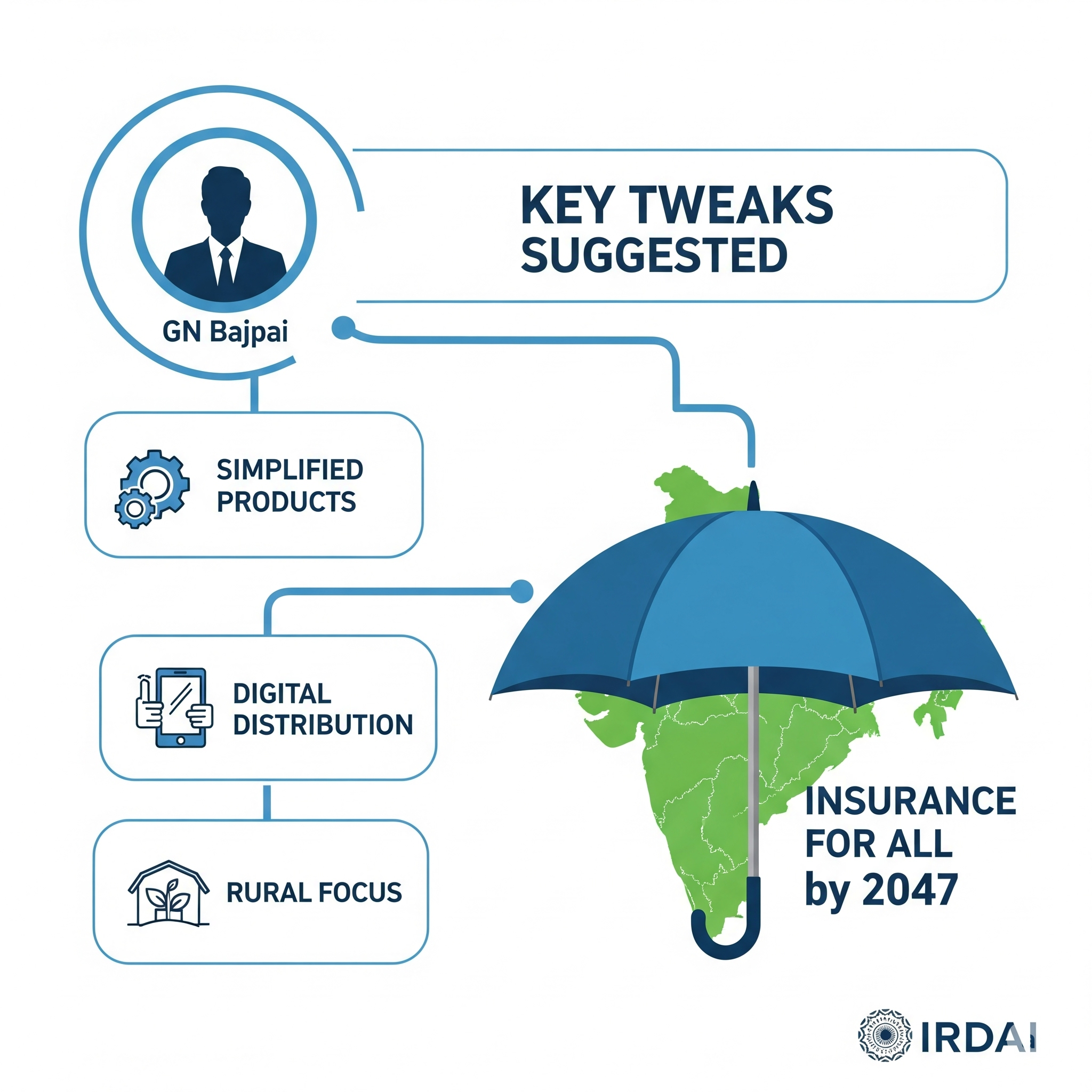
India Insurance Coverage by 2047: GN Bajpai Suggests Key Tweaks to IRDAI’s Insure India Plan
The India Insurance Coverage by 2047 mission, envisioned under IRDAI’s Insure India programme, aspires to ensure that every insurable citizen and property in the country is covered. While the ambition is praiseworthy, former LIC and SEBI Chairman GN Bajpai believes that strategic refinements are essential to make this mission truly effective.
IRDAI’s Bold Vision for Insurance Inclusion
The Insurance Regulatory and Development Authority of India (IRDAI) has laid the groundwork for a future where insurance is not a luxury but a basic necessity. Through the Insure India 2047 initiative, the regulator has outlined a framework centred around three foundational pillars:
- Customers
- Providers
- Distributors
With a focus on regulatory reforms, digital infrastructure, simplified claims, and grievance redressal mechanisms, the vision is to make insurance accessible, inclusive, and reliable.
The Insurance Trinity: Bima Sugam, Bima Vistar, and Bima Vahak
1. Bima Sugam – A Digital Marketplace
A unified digital platform to serve as a one-stop destination for the sale and purchase of insurance products. It aims to streamline policy issuance, comparisons, claims, and service requests.
2. Bima Vistar – A Comprehensive Insurance Product
A bundled policy that covers life, health, property, and accidents—with predefined benefits to allow quick, third-party-free settlements.
3. Bima Vahak – A Women-Centric Grassroots Force
A female-led insurance distribution network envisioned at the Gram Sabha level, intended to promote awareness and adoption among rural households, particularly women.
Insurance Is Still a Push Product
Despite advances in technology and digital interfaces, insurance remains a push product—something people don’t naturally seek out but must be persuaded to buy. This is largely because it is:
- An intangible promise redeemable only during a future contingency;
- A financial product that requires contextualised trust-building and active sales intervention.
Even digital-first insurers have had to hire ground-level agents or “feet on the street” to drive customer acquisition. In short, human intermediation is still critical.
India’s Insurance Penetration: A Declining Graph
The expansion of private insurance players post-liberalisation has not significantly improved insurance penetration. The figures are revealing:
| Year | Life Insurance (% of GDP) | Non-Life Insurance (% of GDP) |
|---|---|---|
| 2006 | 4.1% | 0.6% |
| 2021 | 3.2% | 1.0% |
| Current | 2.8% | ~1.0% |
These numbers indicate that despite policy reforms, overall coverage has declined, making the goal of India Insurance Coverage by 2047 even more pressing.
Practical Tweaks for Real-World Success
1. Learn from the Banking Correspondent (BC) Model
India’s financial inclusion journey gained momentum only after the Ministry of Finance and RBI revamped the BC model. Over a million BCs have enabled mass access to:
- Bank accounts
- Direct benefit transfers (DBT)
- Insurance under PMSBY & PMJJBY
This trust-based, ground-level network should now be leveraged to push insurance, especially in rural and underserved areas.
2. Reconsider Commissions for Bima Vahaks
The proposed ₹10–15 commission per policy for Bima Vahaks is far too meagre for a product that demands persuasive selling and follow-ups. Even under PMSBY, a ₹436 policy yields only ₹32 commission.
Without meaningful financial incentives, Bima Vahaks may not sustain motivation. A low-margin, high-volume model, with cross-selling of insurance and NPS by BCs, could offer better viability.
3. Encourage Corporate Bima Vahaks for Scale
Involving corporate-level insurance intermediaries as Bima Vahaks could bring professionalism, volume, and reach—especially in semi-urban and urban clusters.
4. Avoid State Monopolies in Insurance Distribution
Assigning one insurer per state may lead to:
- Service monopolies
- Reduced competition
- Low responsiveness
Instead, the multi-provider approach of Jan Dhan’s sub-service area model ensures:
- Healthy competition
- Improved outreach
- Enhanced accountability
5. Use Verified Bank KYC Data
India already has over 1.3 billion bank account holders whose KYC is complete through Aadhaar, PAN, or other RBI-approved means. This should be re-used instead of enforcing redundant KYC processes in insurance.
6. Dynamic Pricing Over Flat Premiums
While a single fixed premium may sound inclusive, it leads to cross-subsidisation. Ideally:
- Premiums should reflect actual risk profiles
- Risk-based pricing brackets should be introduced
- Bima Vahaks should be trained in risk assessment to explain pricing transparently
This will preserve simplicity while improving fairness and sustainability.
7. Mass Awareness Campaigns Beyond Traditional Ads
To create true insurance awareness across demographics:
- Use short, regional-language films in roadshows
- Partner with NGOs, SHGs, schools and colleges
- Tap into community leaders and trusted local institutions
Traditional media has limitations—grassroots education and cultural relevance are essential.
Conclusion: A Well-Intentioned Blueprint, Ready for Refinement
The IRDAI’s India Insurance Coverage by 2047 mission has all the right ingredients—vision, digital tools, and policy intent. However, as GN Bajpai wisely puts it, the execution strategy must respect the unique nature of insurance as a “push product” requiring grassroots persuasion and human trust.
“Well begun is half done,” as the saying goes. But the second half will require bold, market-appropriate course corrections—and the time to act is now.
Highlights: Insure India 2047 Plan at a Glance
| Component | Objective / Suggestion |
|---|---|
| Bima Sugam | Digital marketplace for all insurance products |
| Bima Vistar | Bundled policy with life, health, accident, and property cover |
| Bima Vahak | Women-led grassroots distribution network |
| Low Commission Concern | Push for better commissions or cross-selling with BC model |
| Avoid Monopolies | Multi-provider approach per region/state |
| Use Existing KYC | Avoid duplication; utilise verified banking KYC |
| Tiered Premiums | Risk-based pricing for fairness |
| Campaign Strategy | Grassroots outreach via NGOs, schools, and roadshows |
Detailed Disclaimer
Disclaimer:
This article titled “India Insurance Coverage by 2047: GN Bajpai Suggests Key Tweaks to IRDAI’s Insure India Plan” has been prepared by Estabizz Fintech for informational purposes only. It reflects a professional interpretation of public commentary made by GN Bajpai, former Chairman of LIC and SEBI, as published in the press.
Estabizz Fintech makes no warranties as to the completeness, accuracy, or reliability of the information presented herein. This publication is not intended to serve as legal, financial, or insurance advisory. Readers are advised to consult certified experts and refer to official regulatory communications issued by IRDAI before taking any action.
For official information, please visit the IRDAI website.
Star Health Insurance and Finequs Partner to Expand Access to Health Insurance Throughout Bharat
Health Insurance Claims Revolutionized: IRDAI’s Game-Changing Circular