NBFC Retail Credit Market Growth to Expand Investor Base – CRISIL Report
NBFC Retail Credit Market Growth to Expand Investor Base – CRISIL Report
Executive Summary / Key Highlights
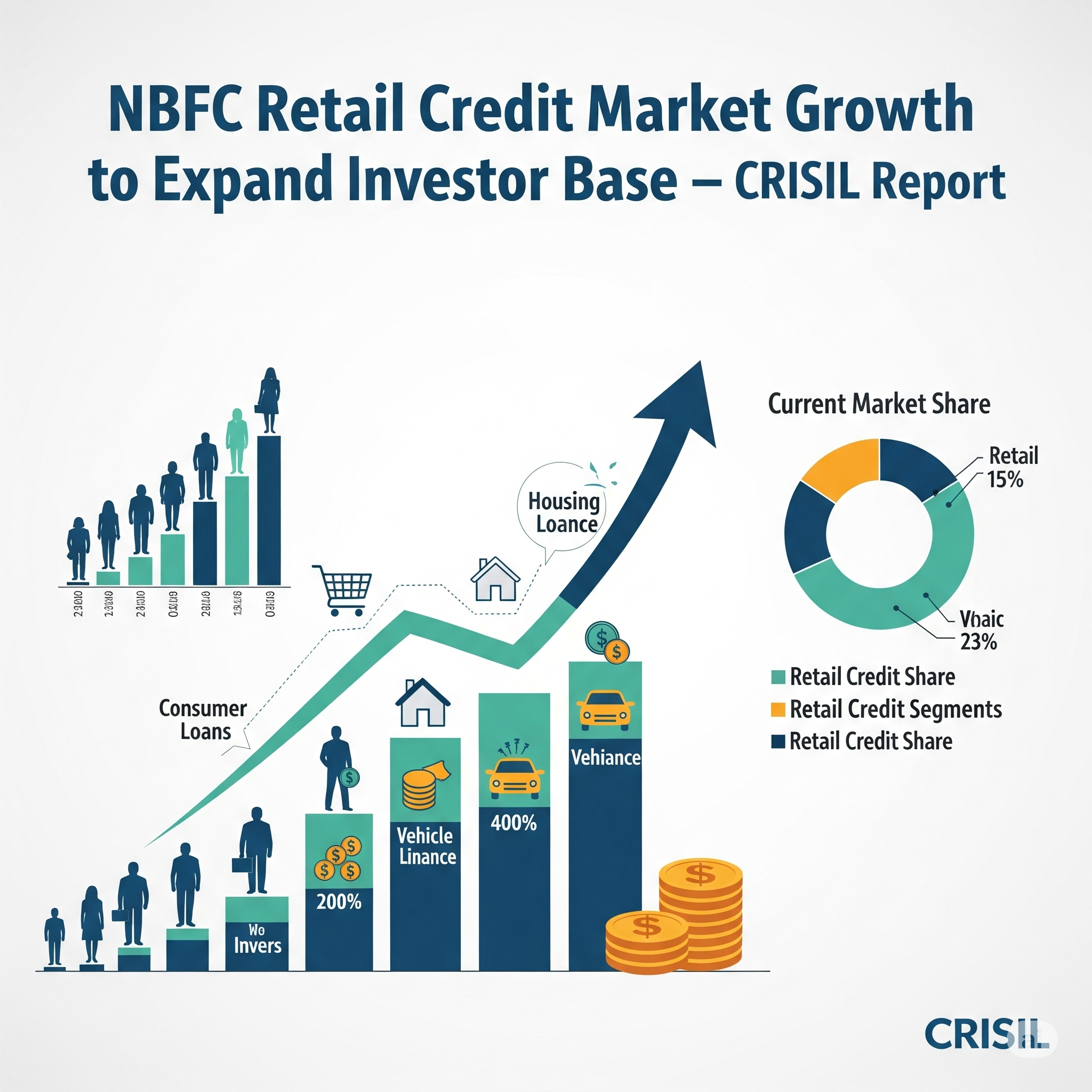
- CRISIL Intelligence projects 14–16% CAGR in the Indian retail credit market between FY25–FY28.
- NBFCs are poised to expand their investor base and diversify funding channels.
- FY25 retail credit stood at ₹82 trillion, with 14% growth in the year.
- Key growth drivers: housing finance, vehicle loans, gold loans, personal loans, and credit cards.
- India’s credit-to-GDP ratio (42% for households) remains lower than global peers, indicating untapped market potential.
- Financial inclusion, digital lending, and fintech partnerships expected to drive credit penetration.

Definition and Scope
Retail Credit Market refers to lending provided to individual borrowers for consumption or personal purposes, including housing, vehicle finance, education loans, credit cards, and personal loans.
In India, NBFCs operate under the Reserve Bank of India Act, 1934, and are regulated by the Master Directions – Non-Banking Financial Company – Systemically Important Non-Deposit taking Company and Deposit taking Company (Reserve Bank) Directions, 2016.
Retail credit forms a significant portion of NBFC portfolios, and with RBI tightening prudential norms, NBFCs are increasingly diversifying funding to maintain growth momentum while ensuring regulatory compliance.
Applicability
The retail credit market growth opportunity is most relevant for:
| Entity Type | Why Relevant |
|---|---|
| NBFCs (Deposit-taking & Non-Deposit taking) | Can expand funding sources and investor categories. |
| Housing Finance Companies | Rising demand in mortgage and affordable housing segments. |
| Fintech Lenders | Ability to partner with NBFCs to penetrate underserved markets. |
| MSMEs offering consumer durable financing | Growing EMI-based retail consumption. |
| Microfinance Institutions | Untapped rural lending demand. |
Step-by-Step Process – How NBFCs Can Leverage Retail Credit Growth
| Step | Action | Compliance/Regulatory Check |
|---|---|---|
| 1 | Identify high-growth retail credit segments | Review RBI prudential norms on sectoral exposure |
| 2 | Build diversified funding base (retail NCDs, institutional investors, securitisation) | Ensure adherence to RBI’s NBFC funding guidelines |
| 3 | Partner with fintechs for distribution | Comply with RBI’s Digital Lending Guidelines, 2022 |
| 4 | Expand in underserved geographies | Maintain KYC/AML compliance per PMLA 2002 |
| 5 | Monitor credit quality | Implement RBI-mandated NPA classification norms |
Eligibility Criteria & Required Documents for NBFC Funding Expansion
| Eligibility Criteria | Required Documentation |
|---|---|
| RBI-registered NBFC | RBI Certificate of Registration |
| Minimum Net Owned Fund per category | Audited financial statements |
| CRAR as per RBI norms | Quarterly regulatory filings |
| Strong credit underwriting processes | Board-approved lending policy |
| Diversification plan for funding sources | Investor presentation & prospectus (for NCDs) |
Fees, Penalties, and Timelines
- Funding Arrangements: Costs depend on the source (bank loans, bonds, securitisation) and investor profile.
- Regulatory Penalties: RBI can impose monetary penalties for violation of exposure norms, inadequate KYC compliance, or mis-selling.
- Timelines: Strategic funding diversification typically requires 6–12 months for execution, depending on approvals and investor due diligence.
Case Study – NBFC Expanding Investor Base
Example: A mid-sized NBFC focused on gold loans saw 20% annual portfolio growth but faced concentration risk in bank borrowings. Post-CRISIL sector projections, it:
- Issued listed NCDs to tap retail investors.
- Partnered with a fintech platform to offer instant personal loans.
- Expanded into tier-3 cities for microfinance lending.
Result: Funding cost reduced by 0.75%, and loan book grew 18% YoY without breaching RBI prudential norms.
Regulatory Updates & Amendments (FY25)
- RBI tightened provisioning norms for unsecured retail loans to curb risk build-up.
- Digital Lending Guidelines (2022) continue to apply to NBFC–fintech partnerships.
- Credit flow to MSMEs and rural borrowers incentivised via government credit guarantee schemes.
- SEBI relaxed NCD listing norms for NBFCs to encourage retail participation in bond issues.
Expert Insights
“The CRISIL projections reaffirm that India’s retail credit story is still in its early innings. For NBFCs, this is not just a lending opportunity but a strategic inflection point to recalibrate funding models,” says Estabizz Fintech.
Every successful lending business starts with a strong business plan. Estabizz helps you create it right
“Investor diversification isn’t just about raising funds; it’s about future-proofing NBFC balance sheets against shocks in any single funding channel.”
Frequently Asked Questions (FAQs) – NBFC Retail Credit Market Growth
1. What is meant by NBFC retail credit market growth?
NBFC retail credit market growth refers to the increase in lending by Non-Banking Financial Companies to individuals for personal consumption or investment purposes, such as housing loans, vehicle loans, gold loans, and personal loans. The CRISIL report projects a 14–16% CAGR in this segment between FY25–FY28.
2. Why is NBFC retail credit market growth important for investors?
It indicates expanding business opportunities for NBFCs, better asset diversification, and the potential for higher returns for investors through NCDs, securitisation, and equity participation.
3. What CAGR has CRISIL projected for the NBFC retail credit market?
CRISIL projects a compound annual growth rate (CAGR) of 14–16% for the Indian retail credit market between FY25 and FY28.
4. What was the total size of India’s retail credit market in FY25?
As of FY25, the retail credit market in India stood at ₹82 trillion, growing 14% year-on-year.
5. Which retail lending products are driving NBFC retail credit market growth?
Key drivers include housing finance, vehicle loans, gold loans, education loans, personal loans, consumer durable financing, credit cards, and microfinance.
6. How does India’s household credit-to-GDP ratio compare globally?
India’s household credit-to-GDP ratio is 42%, compared to China’s 60%, the USA’s 69%, and the UK’s 76%, showing significant room for growth.
7. Why do NBFCs need to expand their investor base now?
To reduce reliance on bank borrowings, lower funding costs, and strengthen financial stability in a growing but competitive market.
8. What is the role of CRISIL’s report in influencing NBFC funding strategies?
The CRISIL report provides market projections, penetration analysis, and sector insights that help NBFCs identify high-growth areas and adjust funding models accordingly.
9. How can NBFCs diversify their funding sources?
NBFCs can raise funds via non-convertible debentures (NCDs), securitisation of loan portfolios, retail bonds, institutional debt, and equity infusion.
10. What is securitisation in NBFC funding?
Securitisation involves pooling loans and selling them as tradable securities to investors, allowing NBFCs to free up capital and expand lending.
11. What government initiatives are boosting NBFC retail credit market growth?
Schemes like PMAY (housing), MUDRA loans, Stand-Up India, and digital lending frameworks under RBI are enabling better access to retail credit through NBFCs.
12. How does financial inclusion impact NBFC retail credit market growth?
Financial inclusion expands the customer base for NBFCs by bringing underserved and unbanked populations into the formal credit system.
13. Are NBFC retail loans riskier than bank loans?
Not necessarily. While some NBFCs operate in higher-risk segments, many maintain strong underwriting standards and collateral-backed lending to mitigate risks.
14. What is the current share of unsecured loans in NBFC retail lending?
Unsecured loans typically make up 10–15% of the retail loan book for most NBFCs, but this varies depending on business strategy.
15. How does the credit card segment contribute to NBFC retail credit market growth?
NBFCs offering credit cards are tapping into rising consumer spending, which drives higher interest income and cross-selling opportunities.
16. Which NBFC segments are expected to see the fastest retail loan growth?
Gold loans, personal loans, and consumer durable financing are likely to see the fastest growth due to rising middle-class consumption.
17. What role do fintech partnerships play in NBFC retail credit expansion?
Fintech tie-ups allow NBFCs to leverage digital onboarding, alternative credit scoring, and faster loan processing, helping them scale faster.
18. How can NBFCs attract foreign investors?
By demonstrating consistent growth, maintaining strong asset quality, obtaining high credit ratings, and complying with RBI regulations.
19. Is NBFC retail credit market growth sustainable?
Yes, given India’s low credit penetration, rising incomes, and strong economic fundamentals, but it requires prudent risk management.
20. How does India’s overall credit-to-GDP ratio compare to other countries?
India’s overall credit-to-GDP ratio is 93%, compared to 138% for the UK and 198% for China, indicating significant growth potential.
21. What risks can slow NBFC retail credit market growth?
Economic slowdowns, rising interest rates, regulatory tightening, and asset quality deterioration can affect growth.
22. How do NBFCs maintain liquidity while expanding retail lending?
By balancing short-term borrowings with long-term debt instruments and using securitisation to recycle capital.
23. Can NBFCs compete with banks in retail lending?
Yes, NBFCs often target niche segments, offer faster loan approvals, and provide flexible repayment structures that give them a competitive edge.
24. How does housing finance contribute to NBFC retail credit market growth?
Housing loans are a major portfolio segment, benefiting from government subsidies and urbanisation trends.
25. Why are vehicle loans important for NBFC retail growth?
Vehicle loans, especially in rural areas, help NBFCs tap into a large customer base with collateral-backed lending.
26. How does gold loan demand impact NBFC growth?
Gold loans are popular for quick, short-term financing and have low credit risk due to secured collateral.
27. What is microfinance’s role in NBFC retail lending?
Microfinance serves low-income borrowers, driving financial inclusion and contributing significantly to loan portfolio diversification.
28. How can NBFCs lower funding costs while expanding?
By improving credit ratings, attracting long-term investors, and accessing lower-cost borrowings from capital markets.
29. Why is credit penetration in India still low?
Limited financial literacy, lack of formal income documentation, and rural accessibility challenges are key factors.
30. How will digital lending regulations impact NBFC retail growth?
They will improve transparency, reduce fraud, and build borrower trust, aiding sustainable growth.
31. What role do institutional investors play in NBFC funding?
Institutional investors provide large-scale funding through bonds, debt instruments, and equity stakes.
32. Are NBFC retail loans regulated differently from bank loans?
Yes, while both follow RBI guidelines, NBFCs have slightly different compliance frameworks and capital adequacy requirements.
33. How do personal loans affect NBFC profitability?
Personal loans have higher yields but also higher risk, requiring careful credit assessment.
34. What is the importance of credit bureaus in NBFC retail lending?
Credit bureaus help NBFCs assess borrower history, reduce default risks, and improve portfolio quality.
35. How do rural credit demands influence NBFC growth?
Rural markets present untapped opportunities for NBFCs, especially in agriculture loans, gold loans, and microfinance.
36. What role do non-convertible debentures (NCDs) play in NBFC funding?
NCDs allow NBFCs to raise capital directly from investors, often at competitive interest rates.
37. How does consumer durable financing contribute to NBFC retail growth?
It enables customers to purchase household goods on EMI, driving both consumption and lending volumes.
38. Why do investors prefer NBFCs with a diversified retail portfolio?
A diversified loan book spreads risk and ensures more stable income streams.
39. What is the projected growth for retail credit in FY26?
Retail credit is expected to continue growing at 14–16% annually, led by housing, auto, and personal loan segments.
40. How do NBFCs mitigate non-performing asset (NPA) risks?
Through stringent credit checks, portfolio monitoring, and recovery mechanisms.
41. Can NBFC retail lending be fully digital?
Yes, many NBFCs are adopting end-to-end digital lending models, reducing processing time and costs.
42. How does urbanisation drive NBFC retail growth?
Urbanisation increases demand for housing, vehicles, and consumer goods, all of which require financing.
43. What is the link between GDP growth and retail credit demand?
Higher GDP growth typically leads to increased disposable incomes, boosting retail credit demand.
44. How does NBFC retail lending help economic development?
By providing accessible credit, NBFCs stimulate consumption, business expansion, and job creation.
45. Are NBFC retail loans more expensive than bank loans?
Sometimes, but NBFCs compensate with faster approvals, customised products, and easier eligibility.
46. Why are foreign investors looking at NBFC retail lending?
India’s growth potential, low credit penetration, and rising middle-class consumption make it attractive.
47. How do NBFCs balance secured vs. unsecured lending?
They set internal caps and adjust based on market conditions and risk appetite.
48. Can NBFCs issue credit cards directly?
Some NBFCs have licences or partnerships to issue credit cards, tapping into growing consumer demand.
49. What is the role of credit guarantee schemes for NBFC retail lending?
These schemes reduce lending risk for NBFCs and encourage them to serve underserved borrowers.
50. What should borrowers consider before taking a retail loan from an NBFC?
They should review interest rates, fees, repayment terms, and compare with alternatives to ensure affordability.
Rise in Credit Demand Enables NBFCs to Expand Investor Base, Says Crisil Report
The Indian retail credit market, according to a recent report by Crisil Intelligence, has been growing at a rapid pace and is projected to register a compound annual growth rate (CAGR) of 14–16% between FY25 and FY28.
The rising demand in India’s retail credit market has created fresh opportunities for Non-Banking Financial Companies (NBFCs) to widen their investor base. The Reserve Bank of India (RBI) framework for NBFCs is also helping boost investor confidence.
Strong Growth Trajectory
The report highlights the consistent double-digit growth seen in India’s retail credit space and predicts continued momentum. It states:
“The increasing demand and positive sentiments in the Indian retail credit market present an opportunity for both banks and NBFCs to broaden their investor base.”
With more retail borrowers entering the system, NBFCs can diversify funding sources and attract new categories of investors.
The National Statistical Office (NSO) reports that retail credit in India stood at ₹82 trillion in FY25, reflecting a CAGR of 15.1% between FY19 and FY25. In FY25 alone, retail credit grew by 14%, driven by demand in housing finance, gold loans, education loans, vehicle financing, consumer durables, personal loans, credit cards, and microfinance.
Consumption-Led Surge in Credit Card Usage
The surge in credit card usage and personal loan demand has significantly contributed to retail credit expansion.
The World Bank’s financial inclusion index also suggests that India’s household credit-to-GDP ratio is only 42%, compared to China’s 60%, the US’s 69%, and the UK’s 76%, indicating massive growth potential. (Source: World Bank Data)
Credit Penetration Gap
India’s overall credit-to-GDP ratio was 93% in CY2024, compared to 138% for the UK and 198% for China. This gap, combined with financial literacy initiatives by SEBI and RBI’s push for digital lending, opens significant headroom for NBFC-led retail credit growth.
Driving Factors Behind the Growth:
- Financial Inclusion Push – Government initiatives like Pradhan Mantri Jan Dhan Yojana (PMJDY) and MUDRA Loans.
- Digital Lending Ecosystem – Collaboration with fintech platforms for faster loan processing.
- Underserved Segments – Penetrating rural and semi-urban markets.
- Alternative Credit Scoring – Using data analytics to serve new-to-credit customers.
RBI Warns NBFCs: Economic Stability at Risk with Aggressive Growth Tactics
NBFC’s Face Slower Growth Amid Asset Stress and Rising Fund Costs
“Expert business plans designed for RBI compliance and fast-track approval – because we know the system.”
Conclusion & CTA
India’s retail credit market offers NBFCs a historic chance to scale responsibly, broaden investor bases, and align with financial inclusion goals. However, the opportunity must be pursued within the regulatory perimeter set by the RBI, with robust risk management.
Need help in building a compliant NBFC funding and retail credit growth strategy? Contact Estabizz Fintech for expert guidance on regulatory approvals, funding diversification, and strategic lending expansion.
Disclaimer (Estabizz Fintech)
This article is for informational and educational purposes only and should not be construed as financial, investment, or legal advice. Estabizz Fintech Private Limited is a professional consulting firm specialising in compliance, licensing, and strategic advisory for regulated entities, including NBFCs, fintechs, and financial institutions. While utmost care has been taken in preparing this content based on reliable public sources such as CRISIL reports and RBI guidelines, readers are advised to verify details with official notifications and seek professional consultation before making any business or investment decisions. Estabizz Fintech Private Limited We do not promote excessive borrowing and strongly advise consumers to understand interest rates, repayment obligations, and credit score implications before applying. This article is purely informational and does not constitute financial advice. For personalised guidance, consult a Expert.