Revised Income Tax Bill 2025 – Key Changes & Compliance Guide
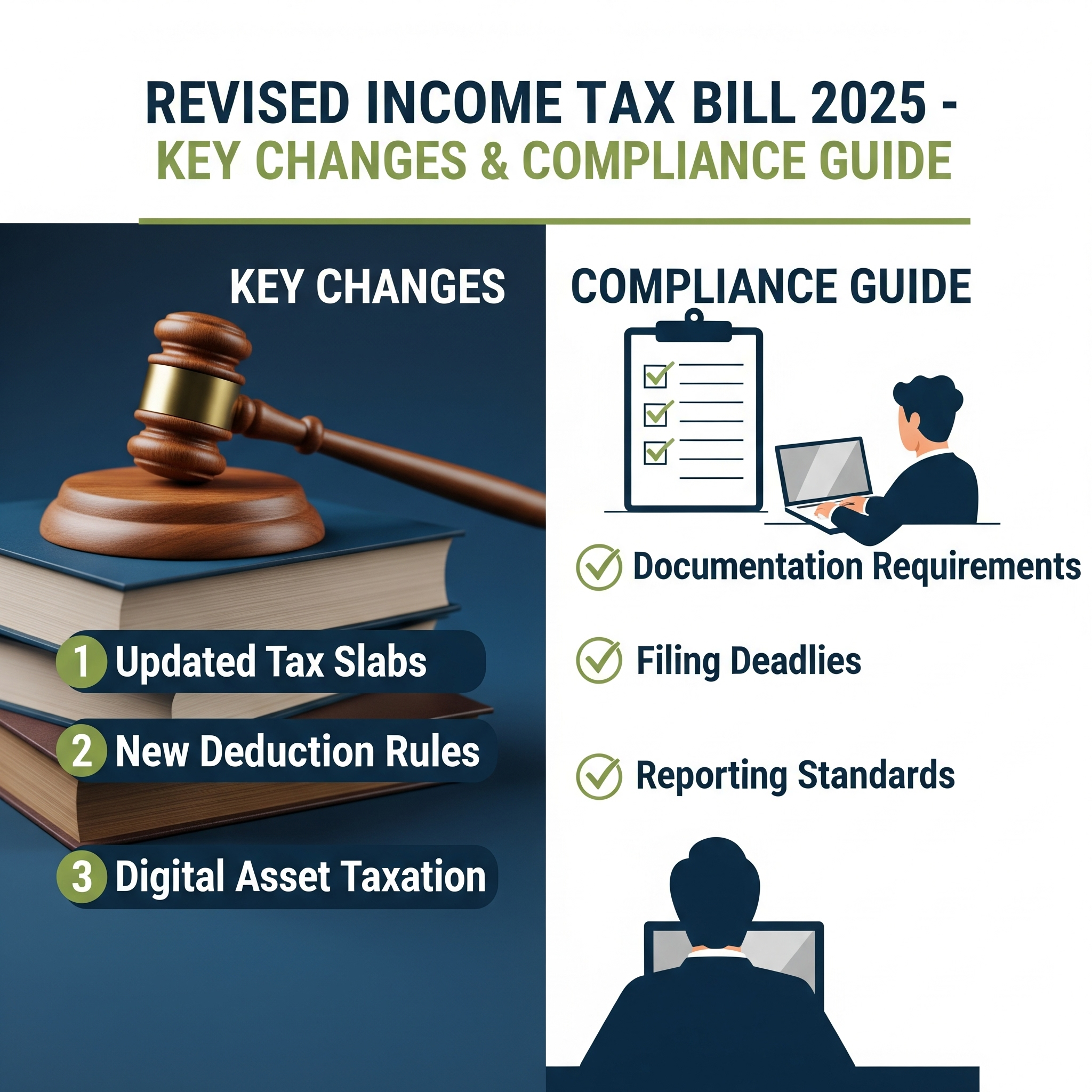
Revised Income Tax Bill 2025 – Key Changes & Compliance Guide
1. Executive Summary / Key Highlights Revised Income Tax Bill 2025
- The Cabinet has approved the Revised Income Tax Bill, 2025, which will replace the Income Tax Act, 1961.
- The revised bill will be tabled in Parliament on August 11, 2025.
- This updated bill incorporates most of the 285 recommendations of the Select Committee chaired by BJP MP Baijayant Panda.
- Focus areas: Simplification, clarity in provisions, reduced disputes, and enhanced taxpayer rights.
- Provisions include continuation of tax exemptions for anonymous donations to charitable trusts, extended timelines for TDS refund claims without penalties, and reforms to benefit MSMEs and startups.
- Expected to impact all taxpayers — individuals, corporates, partnerships, LLPs, trusts, and non-profits.
- MSMEs should prepare for changes in compliance timelines, documentation requirements, and digital tax administration processes.
2. Definition and Scope of the Revised Income Tax Bill 2025
The Revised Income Tax Bill, 2025 is a comprehensive legislative overhaul intended to replace the six-decade-old Income Tax Act, 1961.
Definition (Proposed):
A codified legislation governing the taxation of income in India, applicable to individuals, Hindu Undivided Families (HUFs), companies, firms, LLPs, trusts, and other taxable entities, in accordance with the Union’s power to levy direct taxes under Entry 82 of List I of the Seventh Schedule of the Constitution of India.
Scope:
- Applies to all sources of income – salary, business/profession, capital gains, house property, and other sources.
- Covers resident and non-resident taxation, anti-avoidance provisions, TDS/TCS framework, exemptions, deductions, and dispute resolution mechanisms.
- Provides special provisions for MSMEs, startups, charitable institutions, and non-profits.
- Aligns with global best practices and aims to make India’s tax code simpler, transparent, and litigation-free.
3. Applicability of the Revised Income Tax Bill 2025 – Entity Types, Turnover Limits, and Sector Coverage
| Category | Applicability |
|---|---|
| Individuals & HUFs | All resident and non-resident individuals with taxable income under the new thresholds. |
| MSMEs | All micro, small, and medium enterprises registered under the MSME Act and earning taxable income in India. |
| Startups | DPIIT-registered startups, angel tax compliance entities, and entities availing Section 80-IAC benefits. |
| Corporate Entities | Companies (domestic & foreign), LLPs, and partnership firms engaged in business or profession in India. |
| Trusts & NGOs | Charitable and religious trusts eligible for exemptions; changes in anonymous donation taxation. |
| Sector-Specific | Manufacturing, IT/ITeS, Fintech, Renewable Energy, and other sectors enjoying sectoral deductions. |
4. Step-by-Step Process for Compliance with the Revised Income Tax Bill 2025
| Step | Action | Stakeholder Responsibility |
|---|---|---|
| 1 | Understand applicability based on turnover, sector, and entity structure. | Entity owners, CFOs, tax advisors |
| 2 | Review amended definitions, exemptions, and rates in the new bill. | Compliance team, CA |
| 3 | Update internal accounting and ERP systems to reflect changes in computation. | Finance & IT teams |
| 4 | Align TDS/TCS deduction and deposit timelines as per revised provisions. | Payroll, Accounts Dept. |
| 5 | Revisit advance tax calculation and payment schedules. | Finance head |
| 6 | Maintain updated documentation to support exemptions, deductions, and claims. | Compliance team |
| 7 | File returns using newly prescribed ITR formats (if revised). | Tax professionals |
| 8 | Monitor CBDT notifications and circulars for clarifications. | Compliance head |
| 9 | Conduct year-end compliance review to avoid penalties. | Senior management |
5. Eligibility Criteria & Required Documents under the Revised Income Tax Bill 2025
| Entity Type | Eligibility under Revised Bill | Key Documents Required |
|---|---|---|
| MSMEs | Registered under MSME Act, taxable income > exemption limit. | Udyam certificate, audited financials, GST returns. |
| Startups | DPIIT recognition, incorporation within last 10 years, turnover < ₹100 crore. | DPIIT certificate, incorporation documents, financial statements. |
| Corporates | Domestic/foreign company with taxable presence in India. | Incorporation certificate, PAN, audited accounts. |
| Trusts/NGOs | Registered u/s 12AB or 80G, compliant with annual filings. | Registration certificate, donor list, audited reports. |
| Individuals | Resident/non-resident earning above basic exemption. | PAN, Form 16, investment proofs. |
6. Fees, Penalties & Timelines in the Revised Income Tax Bill 2025
| Compliance | Fee/Penalty | Timeline |
|---|---|---|
| Late ITR filing | ₹5,000 (₹1,000 for income < ₹5 lakh) | By 31 Dec after end of FY |
| Delayed TDS deposit | 1.5% interest p.m. | As per due date of deposit |
| Failure to maintain books | ₹25,000 | Continuous |
| Misreporting of income | 200% of tax due | On assessment |
| TDS refund claim beyond due date | Now allowed without penalty (as per new bill) | N/A |
7. Case Studies / Practical Examples Revised Income Tax Bill 2025
Case 1 – MSME Manufacturer:
A small-scale textile manufacturer in Surat claimed TDS refund after missing the ITR due date. Under the old law, they faced penalty; under the new bill, the claim will be processed without penalty, improving liquidity.
Case 2 – Startup with Angel Funding:
A DPIIT-recognised AI startup faced prolonged assessment on share premium valuation. The new bill proposes clearer guidelines, reducing harassment and enabling faster funding rounds.
8. Regulatory Updates & Amendments (2025) Revised Income Tax Bill 2025
- Anonymous Donations: Continued exemption for donations to registered religious-cum-charitable trusts.
- TDS Refund Window: Taxpayers can claim refunds beyond the ITR due date without penalty.
- Digital Transformation: Increased use of faceless assessments and e-appeals.
- Simplified Language: Drafting is now concise, reducing ambiguity and litigation scope.
9. Expert Insights Revised Income Tax Bill 2025
From a compliance standpoint, this bill is a watershed reform. By incorporating industry feedback and parliamentary recommendations, the government has shown legislative responsiveness. For MSMEs, this is a golden opportunity to align processes with a modern tax code that is less adversarial and more facilitative.
Startups, in particular, will benefit from clearer investment norms and simplified compliance language, enabling them to focus on scaling instead of firefighting tax disputes.
Our advisory to clients is not to wait until FY 2025-26 for implementation. Begin reviewing contracts, ERP configurations, and tax policies now, so that the transition is smooth and penalty-free.
10. Conclusion & CTA Revised Income Tax Bill 2025
The Revised Income Tax Bill, 2025 is more than a legislative update — it’s a strategic opportunity for businesses to future-proof their compliance.
📢 At Estabizz Fintech, we help MSMEs, startups, corporates, and non-profits decode, implement, and stay ahead of regulatory changes.
Contact us today for a personalised compliance roadmap under the new tax regime.
11. Branded Disclaimer Revised Income Tax Bill 2025
Disclaimer: This article has been prepared by Estabizz Fintech Private Limited for informational purposes only and does not constitute legal, tax, or financial advice. While every effort has been made to ensure accuracy as of the date of publication, Estabizz Fintech assumes no responsibility for any errors or omissions. Readers are advised to consult qualified professionals before acting on any information contained herein.
Background & Legislative Journey of the Revised Income Tax Bill, 2025
The Income Tax Bill, 2025 was first introduced in the Lok Sabha on 13 February 2025 with the objective of replacing the Income Tax Act, 1961, a law that had governed direct taxation in India for over six decades.
Referral to Select Committee:
On the same day of introduction, the bill was referred to a Select Committee of Parliament for in-depth examination. This committee, chaired by BJP MP Baijayant Panda, was tasked with reviewing the bill clause-by-clause and engaging in stakeholder consultations.
Stakeholder Consultations Conducted:
The committee’s review process was extensive and inclusive, spanning multiple months and involving:
- Industry leaders from manufacturing, services, and emerging sectors.
- Tax practitioners from Tier-I and Tier-II cities.
- Legal experts specialising in direct taxation and constitutional law.
- MSME associations and chambers of commerce.
- Non-profit organisations affected by exemption provisions.
- Economists analysing macroeconomic impact.
- Civil society representatives advocating for taxpayer rights.
Key Recommendations (285 in total):
- Continue tax exemptions for anonymous donations to religious-cum-charitable trusts.
- Allow TDS refund claims even after the ITR filing due date without penal charges.
- Simplify tax language for better comprehension by non-experts.
- Introduce mechanisms to reduce litigation and disputes.
Report Submission:
On 21 July 2025, the Select Committee submitted a 4,584-page report to the Lok Sabha, containing its full analysis and recommendations.
Cabinet Approval & Withdrawal of Old Bill:
- The government accepted almost all of the committee’s suggestions.
- Certain additional amendments were incorporated to ensure legislative precision.
- The original February 2025 version of the Income Tax Bill was formally withdrawn by Finance Minister Nirmala Sitharaman before Parliament adjourned.
- The revised bill was cleared by the Cabinet and is now scheduled to be tabled in Parliament on 11 August 2025.
Budget Context:
The proposal for a new Income Tax Bill had its roots in the Union Budget 2024, where the Finance Minister emphasised the need for a tax code that was concise, lucid, and less prone to disputes.
Frequently Asked Questions – Revised Income Tax Bill, 2025
General Understanding
1. What is the Revised Income Tax Bill, 2025?
It is a new legislation intended to replace the Income Tax Act, 1961. The revised version, approved by the Cabinet on 9 August 2025, incorporates most of the recommendations of the Parliamentary Select Committee to simplify tax laws, reduce litigation, and make compliance easier for all taxpayers.
2. When will the Revised Income Tax Bill, 2025 come into effect?
Once the bill is passed by both Houses of Parliament and receives the President’s assent, it will be notified with an effective date. The government may choose to implement it from the next assessment year (AY 2026-27).
3. Why was the earlier Income Tax Bill, 2025 withdrawn?
The original February 2025 version was withdrawn because the government wanted to incorporate Select Committee recommendations and address stakeholder feedback for better clarity and legislative precision.
4. Does the revised bill completely replace the Income Tax Act, 1961?
Yes, once enacted, it will repeal the 1961 Act and become the sole law governing income taxation in India.
5. Will the new law change the way income tax is calculated?
While the core computation principles may remain similar, there will be changes in definitions, exemptions, rates, and procedural rules, especially aimed at simplification.
Applicability & Coverage
6. Who will be covered under the new bill?
Individuals, HUFs, partnership firms, LLPs, companies, trusts, and non-residents with taxable income in India.
7. Are MSMEs required to follow the new provisions?
Yes, all MSMEs registered under the MSME Act and earning taxable income must comply with the revised provisions.
8. Are charitable trusts covered under the bill?
Yes. The revised bill continues exemptions for certain donations and clarifies compliance requirements for trusts registered under Sections 12AB and 80G.
9. Does it apply to foreign companies operating in India?
Yes, foreign companies with a taxable presence or income source in India will be taxed under the new provisions.
10. Is the bill applicable to the gig economy and freelancers?
Yes, individuals earning from freelance, gig work, or overseas clients will need to report and pay taxes as per revised provisions.
Key Changes in the Revised Bill
11. What are the major changes proposed in the revised bill?
- Continuation of exemptions for anonymous donations to charitable trusts.
- Extended timelines for TDS refund claims without penalties.
- Simplified drafting to reduce disputes.
- Enhanced digital tax administration.
12. What is the new rule on TDS refund claims?
Taxpayers can now claim TDS refunds even after the ITR due date without incurring penalties, subject to certain conditions.
13. Are income tax slabs being changed?
The revised bill may rationalise slabs for individuals and corporates; final rates will be confirmed when the bill is passed.
14. How does it impact tax litigation?
By removing ambiguities and using simpler language, the bill aims to reduce the number of disputes and the need for prolonged appeals.
15. Will advance tax provisions change?
Timelines may remain similar, but calculation methods and relief provisions could be made simpler.
Procedural & Compliance Aspects
16. Will there be new ITR forms?
The CBDT may release updated ITR forms aligned with the revised provisions, especially for MSMEs and trusts.
17. Will the due dates for ITR filing change?
Core timelines are likely to remain unchanged, but some procedural relaxations may be added.
18. How will assessments be conducted under the new law?
The government plans to continue and expand faceless assessments and appeals to minimise interface with tax officials.
19. Will GST and Income Tax compliance be linked?
While GST remains separate, the government is increasingly cross-verifying GST and income tax data for compliance monitoring.
20. Will digital signatures be mandatory for filing returns?
Entities such as companies, LLPs, and those subject to audit will still need DSCs; individuals can file with e-verification methods.
Sector-Specific Impact
21. How will the revised bill affect startups?
Startups may see simplified compliance for Section 80-IAC benefits and clearer rules for share premium taxation.
22. What changes are expected for MSME taxation?
MSMEs may benefit from simpler depreciation rules, easier loss carry-forward, and faster refund processing.
23. Will charitable trusts face stricter scrutiny?
Yes, while exemptions remain, there will be clear documentation and reporting requirements to claim benefits.
24. Are exporters affected by the changes?
Export incentives and exemptions will be realigned with the new provisions, with digital claim processes.
25. How will it impact fintech companies?
Fintechs must align TDS/TCS processes, digital record-keeping, and compliance reporting with the new framework.
Penalties & Relief Measures
26. Are penalty provisions changing?
The bill proposes rationalisation of penalties to ensure they are proportionate to the offence and reduce harassment.
27. Will there be relief for late filers?
Yes, certain procedural defaults like late TDS refund claims may now be condoned without penalty.
28. What happens if I don’t comply with the new law?
Non-compliance will attract penalties, interest, and in some cases, prosecution under revised provisions.
29. Can penalties be waived?
The CBDT may prescribe conditions for penalty waiver in cases of genuine hardship.
30. Will compounding provisions change?
Yes, compounding rules may be simplified to encourage settlement of disputes.
Transitional Provisions
31. Will I need to re-register under the new law?
No, existing PAN, TAN, and other registrations will continue, but entity details may need updating.
32. How will ongoing assessments be handled?
Assessments initiated under the 1961 Act will be completed under old provisions unless otherwise notified.
33. Will exemptions claimed earlier still be valid?
Yes, subject to the conditions in the new bill; some may have modified compliance requirements.
34. What should businesses do to prepare?
Review internal systems, consult tax advisors, and update compliance calendars for the new law.
35. Will there be training or guidance from the government?
Yes, the CBDT may release explanatory notes, FAQs, and sector-specific guidance.
Technical Clarifications
36. Will Section numbers change?
Yes, the entire structure will be renumbered for logical sequencing, similar to GST law design.
37. Will old case laws still be valid?
Precedents may still be persuasive but will be relevant only where provisions are identical.
38. Will MAT and AMT provisions continue?
The government may rationalise or phase out Minimum Alternate Tax/Alternate Minimum Tax based on feedback.
39. Are international tax rules changing?
Some provisions may be updated to align with BEPS guidelines and India’s tax treaties.
40. Will there be an impact on TCS provisions?
Yes, timelines and rates may be simplified; some exemptions may be removed.
Practical Tips for Compliance
41. Should I revise my accounting software?
Yes, ensure your ERP/tax software reflects new computation logic and compliance workflows.
42. Will there be industry-specific notifications?
Likely, yes — especially for sectors with special tax provisions like IT, agriculture, and manufacturing.
43. Can I get advance rulings under the new law?
Yes, the advance ruling mechanism is expected to continue, possibly in a simplified form.
44. Will refunds be processed faster?
Yes, digital processing and relaxed timelines are expected to speed up refunds.
45. How will dispute resolution improve?
Through simplified drafting, clearer definitions, and enhanced use of faceless systems.
Impact on Individuals
46. Will salaried employees benefit from the bill?
Potentially yes, through simplified exemption claims and possibly revised tax slabs.
47. Will deductions under Sections 80C, 80D continue?
Core deductions may remain but with revised limits or formats.
48. How will NRIs be affected?
NRI residency rules, taxation on global income, and TDS rates may be simplified.
49. Will HUF provisions change?
Basic HUF framework may remain but with clearer definitions for assets and income.
50. Can individuals claim relief for double taxation?
Yes, DTAA relief provisions will continue under the new framework.
India’s AIF Industry Celebrates Landmark Tax Clarity in Budget 2025: Key Amendments Explained
Budget 2025: Simplifying Tax Collection at Source (TCS) – Insights by Estabizz Fintech