SEBI Angel Investor Rules: Will Startup Funding Slow Amid New Accreditation Norms?
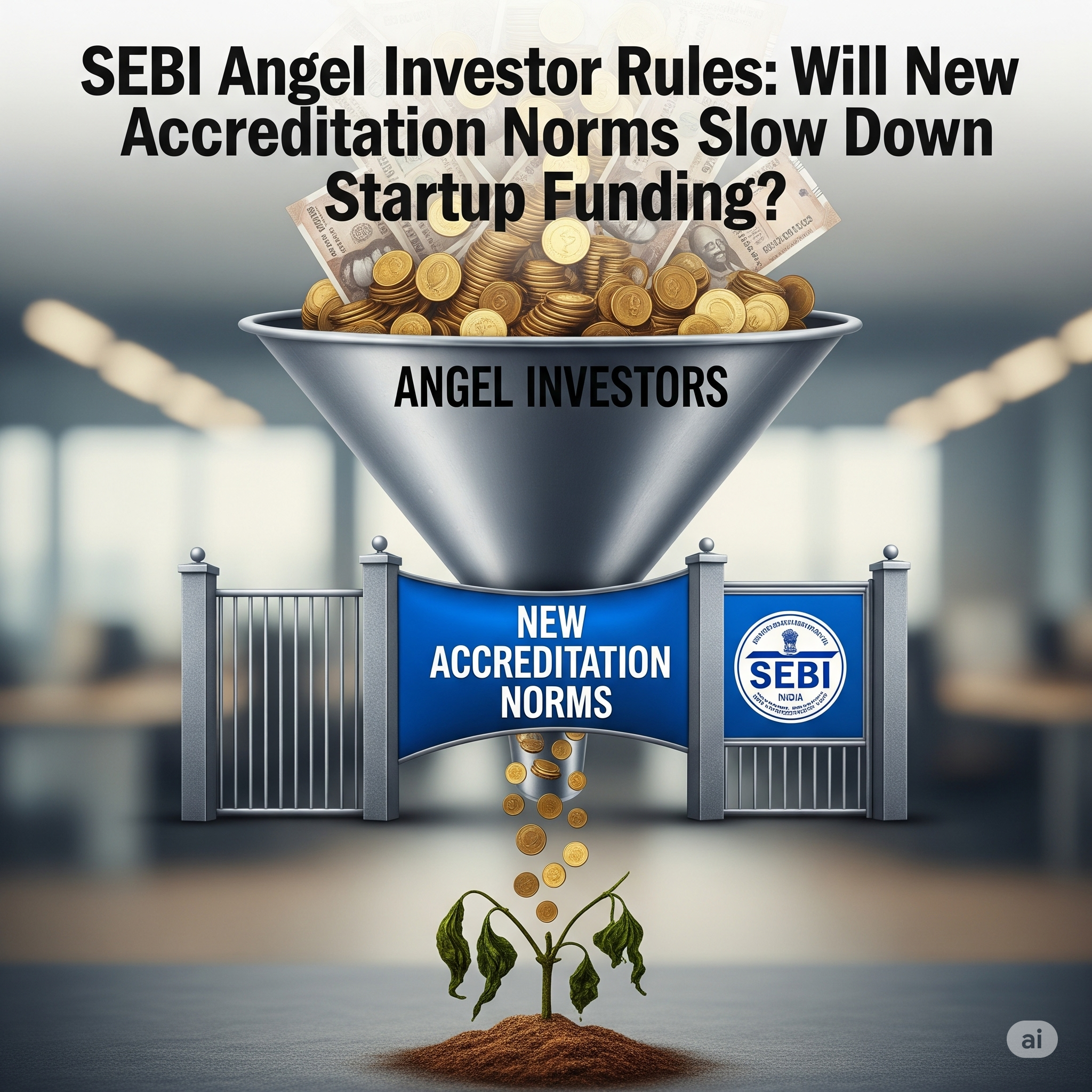
SEBI Angel Investor Rules: Will New Accreditation Norms Slow Down Startup Funding?
🔍 Introduction: SEBI’s Accreditation Mandate and Its Ripple Effect
The Securities and Exchange Board of India (SEBI) has introduced a major regulatory shift, restricting investments in angel funds to only those individuals or entities who qualify as accredited investors (AIs). This move, while aimed at improving governance and accountability in startup investing, has sparked concerns across India’s early-stage startup ecosystem—particularly among angel syndicates, founders in tier-2 and tier-3 cities, and emerging fund managers.
The question on everyone’s mind: Will startup funding slow down in the near term?
🧾 What Are New SEBI Angel Investor Rules?
On 18 June 2025, SEBI updated its regulatory framework for angel funds. The key amendment: only accredited investors can invest in these funds.
👤 Who Qualifies as an Accredited Investor?
To be recognised as an AI, an individual must meet any of the following:
- Annual income of over ₹2 crore
- Annual income of over ₹1 crore and a net worth of over ₹5 crore
- Net worth alone exceeding ₹7.5 crore
This is a sharp departure from SEBI’s 2013 definition, which allowed participation based on:
- Tangible net assets of ₹2 crore (excluding primary residence)
- Prior startup or entrepreneurial experience
- A minimum investment of ₹25 lakh in angel funds
📜 Accreditation Process and Validity
- Timeframe: ~3 business days
- Validity: 2 years
- Cost: ₹12,000
- Agencies: Currently only CDSL Ventures Ltd and NSDL Data Management Ltd
🏗️ What This Means for the Startup Ecosystem
💸 Early-Stage Startups May Bear the Brunt
According to Priyanka Madnani, Founder of Terex Ventures:
“This change will affect pre-seed and seed-stage funding in smaller cities, where startups often rely on personal networks and first-time angels. Until these individuals become accredited, deal flow may slow down.”
Larger cheque sizes from VC firms and institutional co-investment vehicles (CIVs) may continue unaffected, but the grassroots capital base that fuels early innovation could shrink temporarily.
🔁 Syndicates and Emerging Fund Managers Face Operational Challenges
Ashish Bhatia, Founder of India Accelerator, noted:
“Syndicates will need to restructure their models. Many new angels may sit out of deals until they’re accredited. This could delay investments, especially for first-time founders.”
Similarly, Brijesh Damodaran Nair from Auxano Capital added:
“Retail investors now fall out of scope. Many aren’t even aware of the new accreditation process.”
This sudden contraction in investor base could reduce flexibility for Category I AIFs and impact emerging fund managers.
⚠️ Accreditation Capacity and Complexity Concerns
According to SEBI’s May 2025 data, only 750 accredited investors are registered. Experts fear that the current system is too limited to handle India’s growing angel investor community.
Divaspati Singh from Khaitan & Co remarked:
“The setup isn’t built to handle this scale. With only two accreditation agencies, delays are inevitable.”
For foreign investors, the barriers are even higher. Despite having substantial global assets, they are required to submit Indian tax returns—a step seen as unnecessary by many.
“In several countries, investors can simply self-certify. But here, the process is manual and unforgiving,” Singh added.
🔧 What SEBI Is Doing to Address These Concerns
On 17 June, a SEBI consultation paper proposed reforms to smoothen the transition:
🔄 Proposed Improvements:
- Open up accreditation to all KYC Registration Agencies (KRAs)
- Allow AIFs to provisionally onboard investors based on in-house due diligence
- Create standardised SOPs for processing accreditations
Siddarth Pai, Founding Partner at 3one4 Capital, welcomed the consultation paper:
“Letting fund managers initiate accreditation is a good step. But it will only work if KRAs can scale up quickly with consistent procedures.”
📊 Market Data Snapshot
| Metric | Value (as of FY 2025) |
|---|---|
| Angel funds registered (AIF Regs) | 82 |
| Commitments raised by angel funds | ₹10,138 crore |
| Investments made by angel funds | ₹4,134 crore |
| Accredited investors registered (May) | 750 |
🧩 Implications for the Ecosystem
🕒 Short-Term Pain
- Reduced early-stage deal flow
- Barriers for tier-2, tier-3 founders
- First-time angels temporarily sidelined
- Emerging fund managers lose agility
🌱 Long-Term Gain
- Cleaner governance in angel networks
- More serious capital into early-stage deals
- Enhanced investor protection
- Credibility boost for Indian startup investing
📌 Expert Recommendations
- New investors should initiate accreditation proactively to avoid future exclusion.
- Fund managers must educate investors about the process and assist in fast-tracking certifications.
- SEBI is encouraged to offer digital, scalable, and principle-based compliance routes.
- KYC agencies must prepare for increased volume by investing in tech and SOP standardisation.
📝 Disclaimer
This blog is intended for informational purposes only. The regulatory updates covered here reflect SEBI’s evolving stance on angel fund participation and accredited investor norms as of June 2025. Readers are advised to seek expert financial or legal counsel before making investment decisions.
Estabizz Fintech disclaims any liability arising from actions based on this article. For tailored advice on AIF registration, angel fund compliance, or investor onboarding under SEBI norms, reach out to our compliance team at www.estabizz.com.
Revamping RBI and SEBI’s Policy on Overseas Investment for AIFs
Zerodha Makes Investment Advisory Certification Mandatory for Finfluencers