SEBI Penalty Rationalisation: Regulator Plans Softer Terminology to Avoid Broker Stigma
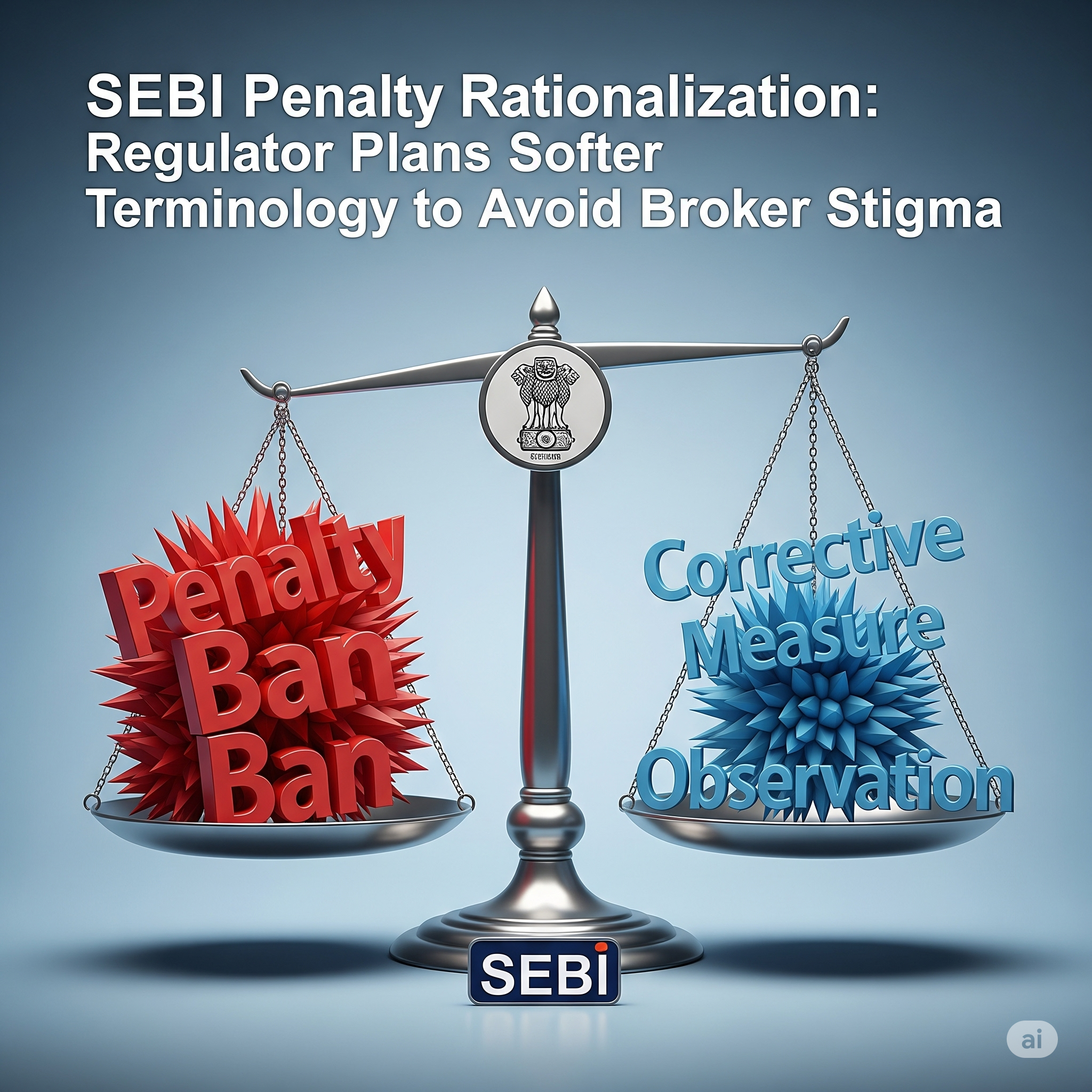
SEBI Penalty Rationalisation: Regulator Plans Softer Terminology to Avoid Broker Stigma
In a move that could significantly reshape regulatory perceptions in Indian capital markets, the Securities and Exchange Board of India (SEBI) is set to rationalise its penalty framework. According to Kamlesh Varshney, Whole-Time Member of SEBI, many regulatory actions currently termed as “penalties” are, in reality, procedural or compliance-related levies—and mislabelling them creates an unintended stigma on brokers and market intermediaries.
🔍 Why SEBI penalty rationalisation Wants to Revisit the Definition of ‘Penalty’
Speaking at a recent industry event, Varshney elaborated on SEBI’s concerns. “We’re seriously looking at how penalties are defined, categorised, and disclosed,” he said, noting that many brokers face reputational harm when procedural charges are publicly labelled as ‘penalties.’
He revealed that SEBI had conducted an extensive consultation with brokers in February 2025, where NSE was also present. “We asked the key question: Should all monetary actions be called penalties, or can some be termed differently to reflect the nature of the breach—especially when they are not willful violations?” he added.
This reform initiative falls under SEBI’s broader penalty rationalisation framework, whose first phase is nearing completion.
🧩 Brokers’ Industrial Standard Forum: Involvement & Outcome
The Brokers’ Industrial Standard Forum has played a key role in working with SEBI over the last five months to address this regulatory grey area. “They have identified viable solutions for this language and enforcement challenge,” Varshney confirmed, adding that the first rollout of reforms should occur very soon.
📢 Key Proposal: One Exchange to Impose Penalties
Another part of SEBI’s proposal is to assign a single designated exchange to handle penalty imposition, streamlining the process and avoiding redundancy. Currently, brokers deal with multiple exchanges and overlapping compliance norms, which increases operational friction and leads to inconsistent penalty outcomes.
📊 Common Reporting Portal in the Works
In another important announcement, SEBI is considering the launch of a centralised reporting portal for brokers. Varshney explained that the aim is to unify compliance submissions, eliminating the need for brokers to report separately to different stock exchanges.
This SEBI penalty rationalisation would also aid regulatory efficiency and reduce back-end redundancies. “Instead of brokers reporting their transactions at different exchanges, can we have a common portal? That work is also in progress,” he said.
🧠 Enhancing Investor Participation: New Proxy Advisory Feature
The event also witnessed the launch of a new feature on the SEBI investor e-voting app, which now integrates proxy advisory recommendations to guide retail investors. These insights, offered by independent advisory firms, aim to boost informed shareholder decision-making—especially for investors who lack access to deep analytical tools.
At the launch, SEBI Chairperson Tuhin Kanta Pandey remarked:
“Proxy advisory firms offer research-based perspectives on corporate resolutions. By incorporating their guidance into the e-voting platform, we empower small investors to vote with awareness and conviction.”
🔎 SEBI’s Surveillance Focus in Jane Street Probe
On the sidelines of the event, when asked about SEBI’s investigation into US-based trading firm Jane Street, Pandey clarified that the issue is being handled at a high level of surveillance. He also ruled out over-regulation, asserting:
“More regulations are not necessarily the answer. It’s stronger surveillance and better enforcement that we need.”
He reassured stakeholders that there were no widespread systemic threats currently being observed beyond this case.
🧾 Final Thoughts: A Step Toward Fairness and Efficiency
SEBI’s initiative to redefine penalties and reduce undue stigmatisation is a welcome move for the brokerage industry. By focusing on transparency, proportional enforcement, and streamlined compliance, the regulator is striking a fine balance between market integrity and ease of doing business.
The anticipated reforms—ranging from language softening to common portals—reflect a maturing regulatory ecosystem where investor protection and operational efficiency can co-exist.
⚠️ Disclaimer
This blog is intended for informational purposes only. Readers are advised to consult official SEBI penalty rationalisation circulars and compliance experts before interpreting regulatory positions. The views expressed are summarised interpretations of recent SEBI statements and do not constitute legal or financial advice. Estabizz Fintech does not hold responsibility for changes to regulatory provisions after the date of publication.
Operating Guidelines for Trading Supported by Blocked Amount in Secondary Market -NSE
SEBI Introduces Eased Norms for Large Corporates’ Borrowing from Debt Market