SEBI Venture Capital Restrictions Must Go – Time to Unlock Retail Risk Capital
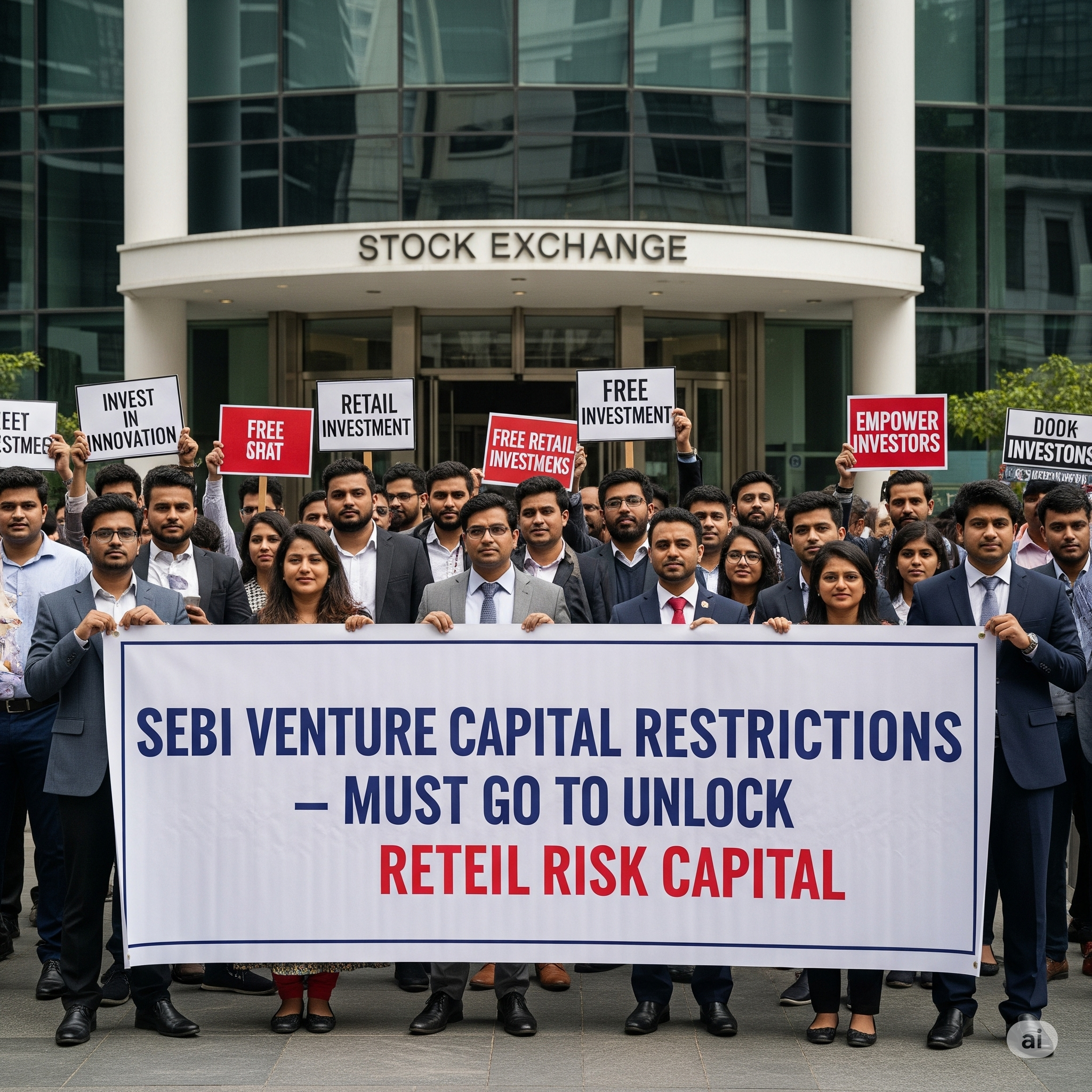
SEBI Venture Capital Restrictions Must Go – Time to Unlock Retail Risk Capital
Retail investors in India are walking a tightrope. From speculative futures and options (F&O) trades to chasing overpriced equities through SIPs, their appetite for risk is undeniable. Yet, they remain barred from one of the most promising corners of the financial ecosystem — venture capital funds.
The time has come for the Securities and Exchange Board of India (SEBI) to reconsider its long-standing policy of restricting public investment in venture capital (VC) funds. If India wishes to build the next generation of global companies, it must empower its own people to back them.
The Jane Street Episode: A Moment of Reckoning
The recent SEBI action against Jane Street Capital, a Wall Street firm accused of manipulating Indian cash and derivatives markets, shook market participants. The firm reportedly made unlawful gains at the cost of Indian retail investors, many of whom continue to return to the F&O segment despite repeated losses.
This moment is akin to America’s famous “shoeshine boy giving stock tips” anecdote before the 1929 crash — a sign that speculative frenzy had gone too far.
Instead of merely tightening surveillance on speculation, SEBI must channel this massive risk appetite toward building value — by allowing investors to fund India’s future startups through regulated VC funds.
Retail Risk Appetite Is Already Evident
- 91% of Indian F&O traders incur losses, SEBI reports confirm.
- India accounts for 60% of global derivatives volumes, often 350–400x its cash market activity.
- Mutual fund investors funnel savings into overpriced large-cap stocks, pushing valuations far beyond fundamentals.
Clearly, the Indian investor is not shy of taking risks. But the avenues they are allowed to access are limited, often speculative, and disconnected from the real economy.
Venture Capital: The Missing Link in India’s Growth Strategy
Venture capital serves a vital function: enabling early-stage enterprises to scale, experiment, and build transformative products. But current SEBI regulations prohibit VC funds from raising money from the general public, fearing retail exposure to extreme risk-reward profiles.
However, as seen in stock markets and even cryptocurrencies, Indian savers are voluntarily embracing risk.
If structured appropriately, VC funds can offer regulated and diversified exposure to high-potential startups. This would not only democratise wealth creation but also deepen India’s innovation ecosystem.
India’s Investment Bottleneck: Too Much Money Chasing Too Few Stocks
India’s top stocks are increasingly overvalued, primarily because there are too few investible alternatives. This stems from:
- Limited number of listed profitable companies
- Conservative capital market expansion
- A cultural and regulatory hesitation to embrace high-risk enterprise
The solution? Grow the base of investible companies by nurturing more startups. And to do that, we need broader participation in venture capital.
The Case for Lifting SEBI Venture Capital Restrictions
Let’s be clear: venture capital is not for everyone. But with minimum ticket sizes, proper disclosures, and lock-ins, it can be made accessible to informed and willing investors.
| Current Framework | Recommended Framework |
|---|---|
| Only institutions or HNIs can invest | Open regulated VC funds to retail investors |
| Retail capital flows into speculative F&O | Redirect towards startup funding |
| High risk with little upside for public | Shared upside in future unicorns |
| No diversification across startups | VC fund model ensures portfolio exposure |
From Shoeshine Boys to Startup Scouts
Imagine a future where ordinary Indians don’t just follow stock tips on Telegram, but actively back VC funds creating India’s next unicorns.
In this vision, the shoeshine boy doesn’t just whisper option tips — he spreads the word about the next great startup, backed by a publicly listed VC fund.
India could become the first country to institutionalise grassroots venture investing—a model that’s not only inclusive but also deeply transformational.
What India Stands to Gain
- More investible companies within Indian markets
- Reduced dependence on speculative trading
- Increased capital efficiency and economic productivity
- Broader wealth creation among Indian citizens
- A self-sustaining innovation economy
Disclaimer:
This article is intended for educational and informational purposes only. It does not constitute legal or investment advice. Regulatory frameworks governing venture capital investments and retail participation are evolving and must be interpreted carefully.
Estabizz Fintech strongly advises all readers to consult with SEBI-registered advisors, financial planners, or legal professionals before making investment decisions. The content reflects the author’s interpretation and is not an official position of SEBI or any other regulatory body. SEBI venture capital restrictions
For structured venture capital advisory and retail participation models, please contact the Estabizz compliance desk.
Alternate investment funds: An industry at risk of death by a thousand circulars
CCI Regulations: Will New Competition Rules Open the Door for More Hostile Takeovers?